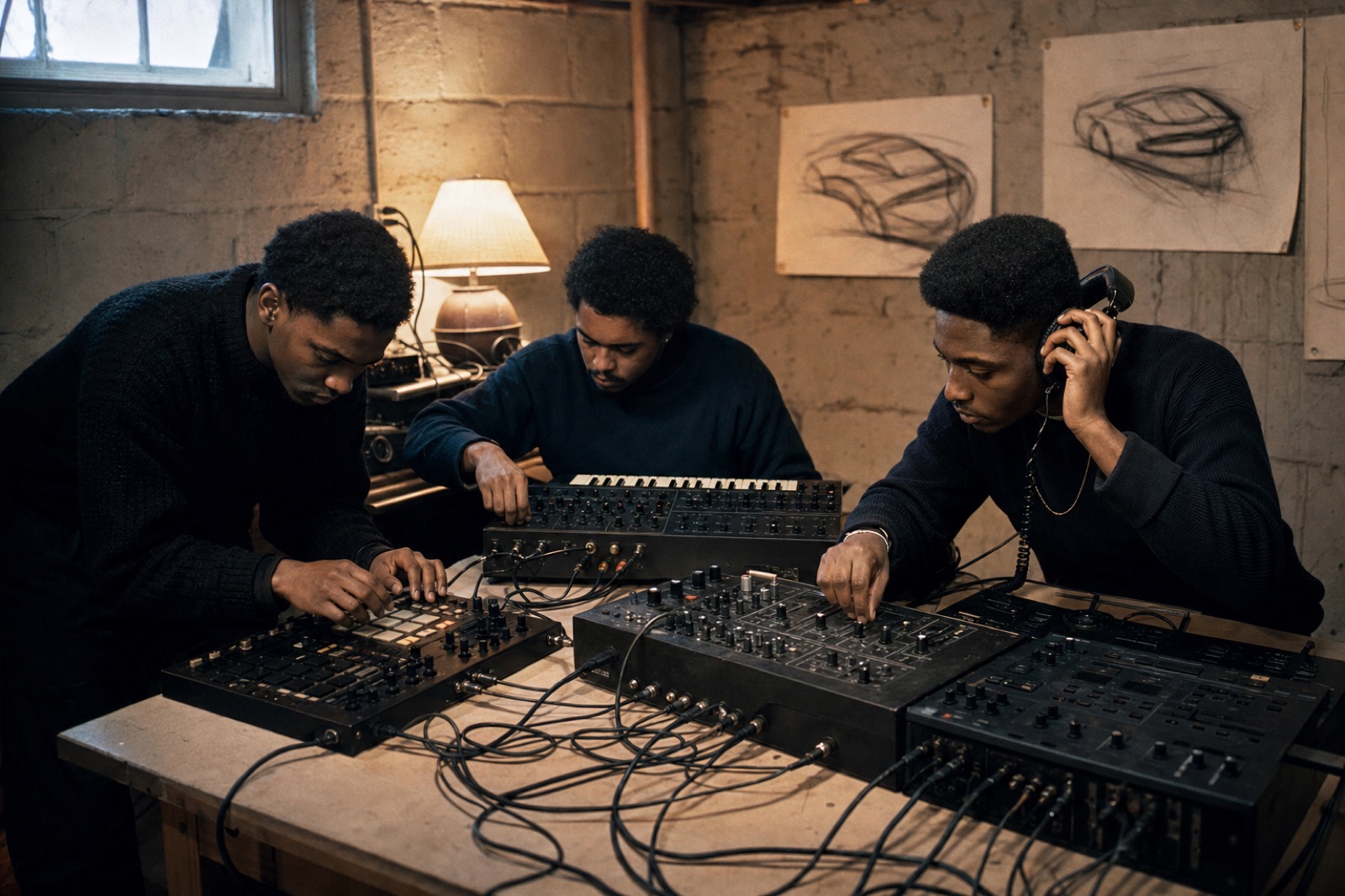
What Is Techno? From Detroit to the Festival
Techno is electronic dance music built from drum machines, synthesizers and repetition, first shaped in and around Detroit in the 1980s by Juan Atkins, Derrick May and Kevin Saunderson. Most of it sits between about 120 and 140 BPM. Berlin became its second home in the 1990s, and Detroit's Movement festival still anchors the sound in the US.
What does techno sound like?
Techno is dance music made for long, continuous DJ sets: a kick drum on every beat, crisp hi-hats and claps, and synthesizer patterns that repeat and change slowly. Ableton's Learning Music course gives 120 to 140 BPM as the typical tempo range. Vocals are rare, and when they appear they tend to be short, repeated samples.
Drum machines do most of the work. Roland launched the TR-909 in 1983 and kept it in production for only about a year, yet the company says no drum machine has powered more house and techno tracks, starting with young producers in Detroit and Chicago. Red Bull Music Academy's history of the machine puts total production at around 10,000 units. Many later sold cheaply in pawn shops and second-hand stores, which is how a generation of producers could afford one, and Kevin Saunderson told RBMA that records made without it sounded noticeably different.
The appeal is in the slow build. Over several minutes a filter opens, a percussion loop drops out and comes back, or a chord stab shifts by a note, and a dance floor that has locked into the groove reacts to each small change. DJs blend one track into the next for the whole set, so a good techno set plays like one long piece of music.
How Detroit's Belleville Three shaped techno
Juan Atkins, Derrick May and Kevin Saunderson are known as the Belleville Three, after the small town outside Detroit where they became friends as teenagers. May has stressed that they were never small-town kids: their families moved out to Belleville for different reasons, and the three bonded over records, radio and DJing at high school parties.
Atkins went first. In 1980 he formed Cybotron with Richard "Rik" Davis, and the duo's 1981 single "Alleys of Your Mind" set synthesizers and drum machines under lyrics about modern paranoia. Their 1983 album Enter combined Kraftwerk's precise electronic programming with Funkadelic's cosmic funk. In 1985 Atkins began recording as Model 500 and launched his Metroplex label; Resident Advisor calls that year's "No UFOs" a foundational Detroit techno release.
Chicago fed the scene, too. As RBMA's history of the two cities tells it, May heard Chicago mix radio in the early 1980s, then caught Frankie Knuckles at the Power Plant and Ron Hardy at the Music Box, and brought records and ideas home. Saunderson's early tracks with Santonio Echols set out to fuse Atkins' Model 500 sound with what Chicago house producers were making. The Chicago side of the story is in What Is House Music?.
Atkins died in Mexico City at 64. Resident Advisor reported his death on November 1, 2026, and its obituary credits him with giving the genre its name.
Where did the name techno come from?
The name stuck in 1988, when the UK label 10 Records released a compilation called Techno! The New Dance Sound of Detroit. Resident Advisor credits Juan Atkins, whose track "Techno Music" appeared on it, with fixing the term. Atkins had been using the word since the Cybotron days, which produced a track called "Techno City."
The story of the title shifts depending on who tells it. Derrick May, in a 2004 interview with Bill Brewster and Frank Broughton that Red Bull Music Academy published in 2017, remembers Atkins telling the British journalist Stuart Cosgrove that they called the music techno, while May spent a year asking Atkins to drop the word. May says the compilation was originally going to be titled The House Sound of Detroit, and that the group sat down with Neil Rushton, who was putting the compilation out in the UK, to settle on a name that set Detroit apart from Chicago.
Early British press sometimes filed the same records under Detroit house, and May has said he let that slide at first because he disliked the word techno, which he linked to an unrelated Miami sound. The 1988 title settled the argument for good.
Underground Resistance and Detroit's harder second wave
By the end of the 1980s a second generation was taking Detroit techno somewhere tougher. Underground Resistance, founded by "Mad" Mike Banks and Jeff Mills, grew out of Banks' earlier group Members of the House. A Red Bull Music Academy feature on the crew's early trips to New York describes UR as harder and more militant than that party-minded band, and member Mike Clark compared the crew to Public Enemy.
The image carried the message. UR shunned interviews, performed in ski masks and black combat gear, and put out records on plain white labels, which kept the focus on the music and on Detroit. Around the turn of the 1990s the crew drove to New York's New Music Seminar to promote its releases, and Mills was offered a residency at the Limelight and stayed. A young Robert Hood was part of the group; Mills later struck out on his own with the Axis label.
Hood's 1994 album Minimal Nation cut tracks down to a kick drum, a hi-hat and a few repeating notes. Writing on its 25th anniversary, RBMA called it a blueprint for that stripped-back sound and suggested it may have inspired the label "minimal techno."
How Berlin became techno's second home
Techno found its second home after the Berlin Wall fell in 1989. Jürgen Laarmann, longtime editor of the German magazine Frontpage, recalls in a Red Bull Music Academy essay how raves spread into former East German buildings after reunification, and how a new kind of club opened on the strip of land where the border had run.
That club was Tresor. Its own history dates the opening to midnight on March 13, 1991, at Leipziger Strasse 126, in a safe-deposit vault in the basement of a former Wertheim building near Leipziger Platz. Tresor Records launched the same year, and the club names Juan Atkins, Underground Resistance and Drexciya as central to its early years, describing the Detroit link as a friendship that also ran through Birmingham in England.
The traffic ran both ways. Jeff Mills spent time living in Berlin, and Juan Atkins has said that demand for his records in Europe is what pulled him back into making music after a break.
Melodic, hard and minimal techno today
Techno now covers many substyles. Three you will see often on festival lineups:
- Minimal techno: sparse, repetitive tracks built from very few sounds. Robert Hood's Minimal Nation (1994) is the usual reference point.
- Melodic techno: arpeggiated synth lines and emotional builds. Mixmag's 2015 profile of Tale Of Us, the Italian duo who later founded the Afterlife label, traces their sound to the melodic, arpeggiated side of techno.
- Hard techno: fast, distorted and relentless. Mixmag's 2026 cover story on the UK scene describes a crowd dancing to a tempo that barely dropped below 150 BPM, well above the classic Detroit range.
Where can you hear techno at US festivals?
Start with Movement Music Festival in Detroit, which grew directly out of the city's techno scene. Several large multi-genre festivals also run dedicated techno stages, and a handful of smaller events book house and techno almost exclusively. The table lists what each festival says about its own programming, with links to our festival pages below it.
Movement's history is worth knowing before you go. According to Red Bull Music Academy's account of the first edition, in 2000, Carl Craig worked with promoter Carol Marvin and the city to put five free stages of house, techno and breakbeats into Hart Plaza on the Detroit River. The festival, now produced by Paxahau, still fills the same riverfront plaza. See more Michigan festivals.
At bigger events, look for the techno room: Ultra Music Festival in Miami runs its RESISTANCE program, and EDC Las Vegas hands its Neon Garden stage to Factory 93. Smaller, focused options include Seismic Dance Event in Austin and Desert Hearts, which moved to northern Arizona in 2024 and skipped its 2026 edition. Every festival we track with techno on the bill is on our techno festivals page, and dates live on the festival calendar.
| Festival | Where | What it says it books |
|---|---|---|
| Movement Music Festival | Hart Plaza, Detroit, Michigan | Grew from the free Detroit Electronic Music Festival (2000); its guide welcomes visitors to the birthplace of techno |
| Ultra Music Festival | Miami, Florida | RESISTANCE, which Ultra presents as its house and techno brand |
| EDC Las Vegas | Las Vegas, Nevada | Neon Garden, curated by Factory 93, with deep house and techno |
| Desert Hearts | Near Flagstaff, Arizona (no 2026 edition) | Bills itself as a tribute to house, techno and love |
| Seismic Dance Event | Austin, Texas | A boutique festival for house, techno and underground music fans |
Techno or house: telling them apart
The two genres share a kick drum on every beat, the same Roland drum machines and a common history, since Detroit and Chicago producers traded records and ideas from the start. House usually runs a little slower, 115 to 130 BPM in Ableton's ranges, and keeps more of disco's warmth: soulful vocals, piano chords and gospel touches. Techno leans on synthesizer textures, repetition and fewer words. When a stage lists both, as Neon Garden and Desert Hearts do, sets can move between the two. Browse house festivals for the other side of the family.
Frequently asked questions
What BPM is techno?
Most techno sits between about 120 and 140 BPM, the typical range Ableton's Learning Music course gives for the genre. Hard techno runs faster: Mixmag's 2026 reporting on the UK hard dance scene describes crowds dancing to tempos that barely drop below 150 BPM.
Who invented techno?
Credit goes to Detroit's Belleville Three: Juan Atkins, Derrick May and Kevin Saunderson. Atkins made some of the earliest records, with Cybotron and as Model 500, and Resident Advisor credits him with naming the genre. A second wave, including Underground Resistance, Jeff Mills and Robert Hood, pushed the sound further.
Is techno from Detroit or Berlin?
Techno began in Detroit in the 1980s. Berlin became its second home after the Wall fell in 1989, when clubs such as Tresor opened in empty buildings and built close ties with Detroit artists. Detroit's own early influences included the German group Kraftwerk, so the connection runs both ways.
What is the difference between techno and EDM?
EDM is a broad label for electronic dance music, and in the US it is often used for big-stage festival styles. Techno, by contrast, is one specific genre under that umbrella, defined by drum machines, repetition and long mixed DJ sets. Large festivals often give techno its own stage, such as Neon Garden at EDC Las Vegas.
Which US festival is most closely tied to techno?
Movement Music Festival in Detroit's Hart Plaza is the one most tied to the genre. It began in 2000 as the Detroit Electronic Music Festival, a free event built around the city's own DJs and producers, and its official guide still greets visitors to the birthplace of techno.
Sources
- Ableton Learning Music: Tempo and genreTypical tempo ranges: techno/trance 120-140 BPM, house 115-130 BPM.
- Roland: The TR-909 StoryTR-909 launched in 1983, produced for about a year, and powered more house and techno tracks than any other drum machine, first in Detroit and Chicago.
- Red Bull Music Academy Daily: Instrumental Instruments: 909 (Matt Anniss, 2016)About 10,000 units made; later sold cheaply in pawn shops; Kevin Saunderson on how the 909 shaped Detroit records.
- Red Bull Music Academy Daily: Interview: Derrick May (Bill Brewster and Frank Broughton, 2017)May's account of Belleville, Atkins naming the music techno to Stuart Cosgrove, the compilation's original title and the decision made with Neil Rushton.
- Resident Advisor: Juan Atkins, techno pioneer and Belleville Three member, dies aged 64 (2026)Atkins' death reported November 1, 2026; Cybotron formed 1980; Model 500, 'No UFOs' and Metroplex in 1985; credits Atkins and his track 'Techno Music' with naming the genre.
- Red Bull Music Academy Daily: Rik Davis: Alleys Of His Mind (Mike Rubin, 2016)Cybotron's 1981 debut single 'Alleys of Your Mind' and its theme of modern paranoia.
- Red Bull Music Academy Daily: Cosmic Cars & Cyberspace: The Prophecies of Cybotron and William Gibson (Miles Raymer, 2016)Cybotron's 1983 album Enter and its Kraftwerk and Funkadelic influences.
- Red Bull Music Academy Daily: Interview: Juan Atkins (2017)Cybotron's 'Techno City'; Atkins on European demand bringing him back to making records.
- Red Bull Music Academy Daily: When Techno Was House (Jacob Arnold, 2017)Chicago's influence on May and Saunderson; the 1988 compilation's planned title, The House Sound of Detroit.
- Red Bull Music Academy Daily: Detroit to NYC: Underground Resistance at New Music Seminar (Ashley Zlatopolsky, 2014)UR founded by Mike Banks and Jeff Mills out of Members of the House; harder, militant sound; white labels; New Music Seminar trips and Mills' Limelight residency.
- Red Bull Music Academy Daily: Jeff Mills on Expanding the Possibilities of Classical Music and DJing (Aaron Gonsher, 2017)UR shunned interviews and performed in ski masks and combat suits; Robert Hood as a member; Mills' Axis label and time in Berlin.
- Red Bull Music Academy Daily: The Making of Minimal Nation, Robert Hood's Techno Masterpiece (Ethan Holben, 2019)Minimal Nation (1994) as the blueprint for stripped-back techno and a possible source of the 'minimal techno' label.
- Tresor Berlin: AboutOpened at midnight on March 13, 1991, at Leipziger Strasse 126; Tresor Records founded the same year; Atkins, UR and Drexciya central to its early years.
- Red Bull Music Academy Daily: Tear Down This Wall: Reunification and the Explosion of Techno in Berlin (Jürgen Laarmann, 2018)Raves in former East German buildings; Tresor in a vault beneath a former Wertheim building on the old border strip.
- Mixmag: DJs of the Year: Tale of Us (2015)Tale Of Us on the melodic, arpeggiated side of techno.
- Mixmag: Get to know Vaal, purveyor of brooding, menacing breaks-infused techno (2019)Tale Of Us set up the Afterlife label.
- Mixmag: How AZYR became the poster boy for the UK's hard dance phenomenon (2026)Hard techno crowds dancing to tempos that barely drop below 150 BPM.
- Red Bull Music Academy Daily: Detroit Electronic Music Festival - The First Year (Michaelangelo Matos, 2015)First DEMF in 2000: Carl Craig and Carol Marvin, free entry, five stages of house, techno and breakbeats in Hart Plaza.
- Movement Music Festival: Start HereOfficial guide welcomes visitors to the birthplace of techno; held in Hart Plaza; produced by Paxahau.
- Ultra Music Festival: Official siteDescribes RESISTANCE as Ultra Worldwide's house and techno festival brand.
- RESISTANCE: Official siteLists RESISTANCE ULTRA Miami among the brand's events.
- EDC Las Vegas: StagesNeon Garden, curated by Factory 93, with deep house and techno.
- Desert Hearts: Official siteDescribes itself as a tribute to house, techno and love.
- EDMTunes: Desert Hearts Skipping 2026 to Refocus on Music and Community (Kade Kleinschmidt, 2025)Desert Hearts, a house and techno collective, announced it would not hold its 2026 festival; it had spent two years at Playa Ponderosa in northern Arizona.
- EDMTunes: Desert Hearts Festival Announces Lineup for 2025 Edition (Anir Ban, 2025)Playa Ponderosa site about 30 minutes outside Flagstaff, Arizona; debuted there in 2024.
- Seismic Dance Event: AboutBoutique Austin festival curated for house, techno and underground music fans.
Written and checked by the EDMber editors. Festival dates come from official festival sites and are re-checked monthly. How we research and correct articles.