What Is House Music? From Chicago to Festivals
House music is dance music born in Chicago in the late 1970s and early 1980s, built on a steady four-on-the-floor kick at roughly 115 to 130 BPM. It grew out of disco, soul and gospel at clubs like Frankie Knuckles' Warehouse and Ron Hardy's Music Box, and today it fills dedicated stages at US festivals such as EDC Las Vegas.
The four-on-the-floor sound of house
House music is built on a four-on-the-floor kick drum, one thump on every beat, usually at about 115 to 130 BPM, the range Ableton's Learning Music course gives for the genre. Over that steady pulse sit hi-hats and claps, a bassline, and elements inherited from disco and soul: piano chords, strings and big vocals.
The City of Chicago's own description, written when it landmarked the Warehouse building in 2023, says the style drew on disco, R&B, gospel and techno, with a driving beat, emotive lyrics and lush orchestration. Larry Heard, one of the first Chicago producers, has said the early house makers had no template, so they took the four-on-the-floor beat from disco and electro records and improvised everything else.
Ableton's lessons make a useful point: a classic house beat is close to a basic rock beat, and the main differences are tempo and small changes to the hi-hat and kick patterns. What makes house feel like house is that steady pulse, plus DJs blending records so the beat never stops.
Frankie Knuckles and the Warehouse
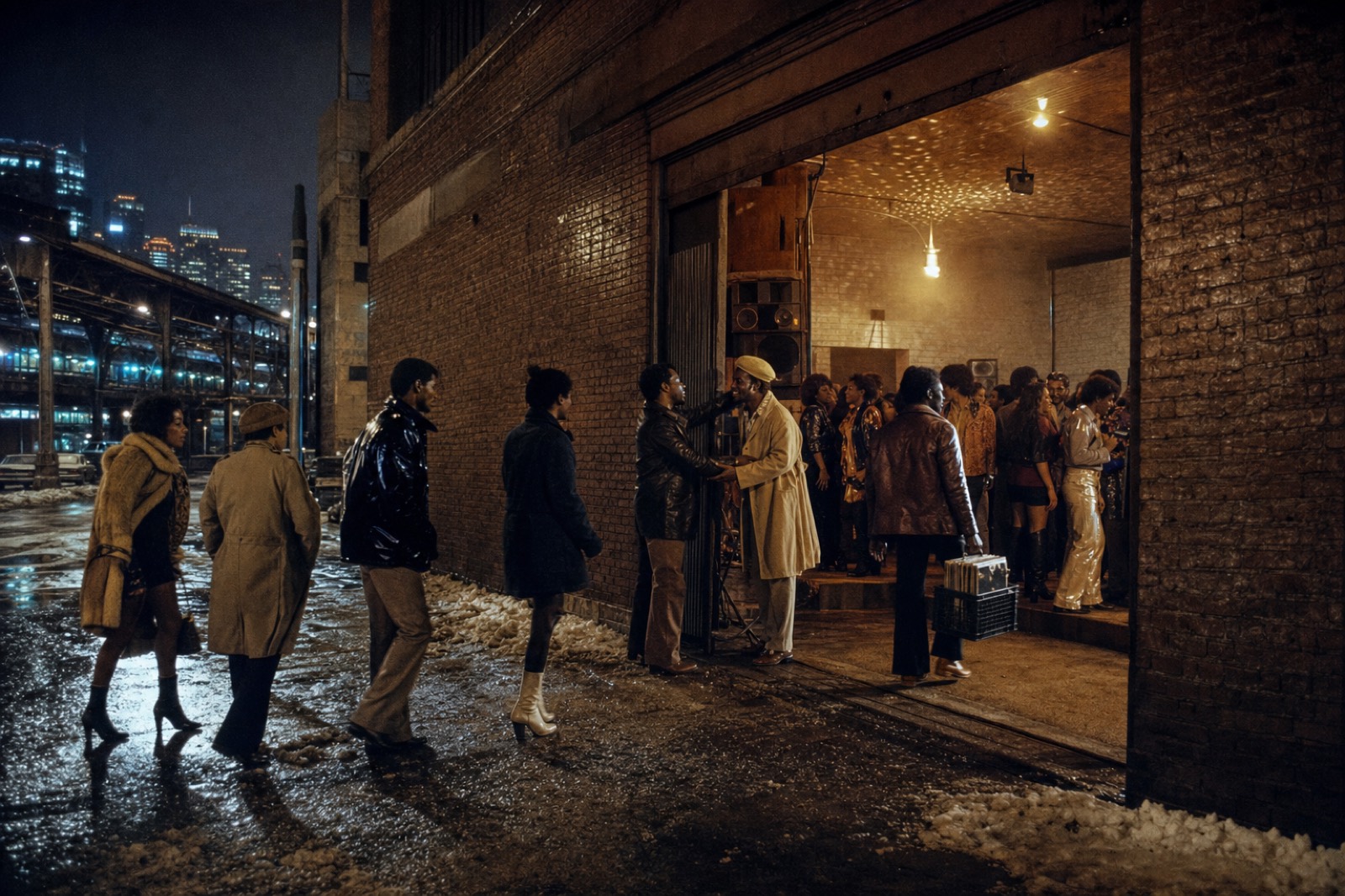
House takes its name and much of its spirit from the Warehouse, a three-story loft building at 206 S. Jefferson St. on Chicago's Near West Side. According to the City of Chicago, it operated as a dance club from 1977 to 1982, and its crowd came largely from the city's Black and Latinx LGBTQ communities.
The club's resident DJ was Frankie Knuckles, born in the Bronx in 1955, who came from New York to play for owner Robert Williams. In a 2011 interview with Red Bull Music Academy, Knuckles described arriving in 1977 in a city whose North Side dance bars mostly catered to white gay crowds and admitted few Black patrons, which left room for an after-hours juice bar playing music Chicago had not heard.
When disco fell out of favor around 1980 and new dance records dried up, Knuckles kept his floor busy by re-editing songs he loved with his friend Erasmo Rivera and by running drum machine patterns between records, starting with an EKO Rhythmaker at the Warehouse. He told RBMA that Derrick May later gave him his first Roland TR-909; May, in his own RBMA interview, remembers selling it to him.
Knuckles left the Warehouse in November 1982 to open his own club, the Power Plant. He went on to win a Grammy as a remixer and died in 2014. In June 2023 the Chicago City Council designated the Warehouse building an official city landmark, which protects its facade and roofline.
Ron Hardy and the Music Box
When Knuckles left, Robert Williams lost the Warehouse lease and opened a new club, the Music Box, in February 1983 at 1632 S. Indiana Ave. The old Warehouse crowd had followed Knuckles to the Power Plant, so Williams hired Ron Hardy, a South Side DJ who had come up at the gay disco Den One, to build a following of his own.
In 1984 the club moved to 326 N. Michigan Ave., on the dark lower level of the double-decked street. Its dancers were younger and mostly Black and straight, with gay, bisexual and trans clubbers of all races in the mix. Hardy played raw, sped-up edits from reel-to-reel tape, laid sound effects over bare drum tracks, and spun tapes from local producers before their songs were ever pressed.
The two DJs drew loyal, rival followings, and DJ Pierre has described the split as almost tribal. A city ordinance limiting juice-bar hours shut the Music Box in 1987. Hardy kept playing at other venues and died in 1992, aged 34.
Why is it called house music?
Every account traces the name to the Warehouse, but they differ on who shortened it. Frankie Knuckles credited his dancers, a Chicago record store credits its own staff, and producer Chip E. has claimed the idea for himself. The City of Chicago's landmark notice sidesteps the question and says only that the genre came to be known as house.
In his 2011 interview, Knuckles explained that DJs throwing South Side parties started advertising his kind of music to attract the Warehouse crowd. The first time he saw a tavern sign reading We Play House Music, he asked a friend what it meant and was told it was simply the music he played at the Warehouse.
The record-store version comes from Importes, Etc., the shop where Knuckles, Hardy and most early Chicago DJs bought their records. RBMA's history of the store says it set up a Warehouse Music section for the records Knuckles was playing. According to Gay Chicago Magazine in 1987, confirmed by former manager Brett Wilcots, display manager Dick Guenther was the first to shorten that sign to House Music. Chip E., who joined the staff later, has said in interviews that he did it.
The versions overlap more than they clash, since each one leads back to the Warehouse and its DJ.
From DJ edits to the first Chicago house records
By the mid-1980s Chicago DJs and producers were making their own tracks on drum machines. Jesse Saunders' "On and On," made with Vince Lawrence, was pressed in early 1984, and Importes, Etc. bought all 1,000 copies. Larry Heard recorded "Mystery of Love" as Mr. Fingers the same year, and both Knuckles and Hardy played his songs from cassette before they came out on vinyl.
The Roland TR-909 helped define the sound. RBMA reports that Ron Hardy used one for the rhythm track of "Sensation," an early Trax Records favorite from 1985, and that drum machines were so scarce they were loaned from house to house around the city. Radio carried the music further, with the Hot Mix 5 DJs mixing records live on WBMX.
Then came the hits. J.M. Silk's "Music Is the Key" sold about 85,000 copies in the US after its 1985 release, and the act topped the UK singles chart the following year with "Jack Your Body." In RBMA's telling, house became a business almost overnight, and Detroit's producers took notice. Their story is in What Is Techno?.
Deep, acid, tech and Afro house in brief
House split into styles early. Four that you will see often on festival lineups:
- Deep house: warm, soulful and musical. Resident Advisor's 2008 profile of Larry Heard credits him with fusing house with musicianship, improvisation and human feeling, and sums that up as deep house.
- Acid house: built on the squelching bassline of Roland's TB-303 synthesizer. Phuture, the Chicago group of DJ Pierre, Spanky and Herb J, released "Acid Tracks" in 1987, and RBMA reports that Ron Hardy played it at least four times on the first night he had it.
- Tech house: a blend of house and techno. Mixmag dates the style to about 1994 and the London party Wiggle, where it was heard as a new mix of the two.
- Afro house: rooted in African, and especially South African, house scenes. Mixmag describes its classic form as deep and progressive, with slow builds and melodic release over intricately syncopated percussion.
Where can you hear house music at US festivals?
Several large US festivals give house its own stage, and a few smaller events are built around house and techno. The clearest examples come from the festivals' own descriptions: EDC Las Vegas runs several house-focused stages, while Desert Hearts, Seismic Dance Event and Ultra's RESISTANCE program all name house as a core sound.
EDC Las Vegas spreads house across several stages. Insomniac's stage guide describes Bionic Jungle as a lineup of house artists, Stereo Bloom as running from house through tech house to bass music, and Neon Garden as a deep house and techno room curated by Factory 93. See more Nevada festivals.
For a smaller crowd, Seismic Dance Event in Austin puts house first in its own description, as does Desert Hearts, which moved to northern Arizona in 2024 and skipped its 2026 edition. In Miami, Ultra Music Festival runs RESISTANCE for house and techno, and Detroit's Movement had house on the bill next to techno at its very first edition. All of them are on our house festivals page, with dates on the festival calendar.
Heading to your first one? Read the first EDM festival guide and what PLUR means before you go.
| Festival | Where | House programming it describes |
|---|---|---|
| EDC Las Vegas | Las Vegas, Nevada | Bionic Jungle (house artists), Stereo Bloom (house to tech house and beyond), Neon Garden (deep house and techno) |
| Desert Hearts | Near Flagstaff, Arizona (no 2026 edition) | A tribute to house, techno and love |
| Seismic Dance Event | Austin, Texas | Curated for house, techno and underground music fans |
| Ultra Music Festival | Miami, Florida | RESISTANCE, presented as a house and techno brand |
| Movement Music Festival | Hart Plaza, Detroit, Michigan | First edition in 2000 had five free stages of house, techno and breakbeats |
Frequently asked questions
What BPM is house music?
Most house runs between about 115 and 130 BPM, the typical range Ableton's Learning Music course gives for the genre. Whatever the tempo, the kick drum lands on every beat, the four-on-the-floor pattern house inherited from disco.
Who is the godfather of house music?
Frankie Knuckles, the resident DJ at Chicago's Warehouse from 1977, is widely called the godfather of house, and Red Bull Music Academy's 2014 obituary used the title. Ron Hardy of the Music Box is the other essential name, known for a rawer style that helped launch acid house.
Why is it called house music?
The name comes from the Warehouse, the Chicago club where Frankie Knuckles played from 1977 to 1982. Accounts differ on who shortened it: Knuckles credited his dancers and South Side party signs, while the record store Importes, Etc. credits its own staff for relabeling its Warehouse Music section.
What is the difference between house and techno?
House came from Chicago and keeps more of disco's warmth, with vocals, piano and gospel touches, usually at 115 to 130 BPM. Techno came from Detroit and leans on synthesizer textures and repetition, usually at 120 to 140 BPM. Both put a kick on every beat and use the same Roland drum machines.
Sources
- Ableton Learning Music: Tempo and genreTypical tempo ranges: house 115-130 BPM, techno/trance 120-140 BPM.
- Ableton Learning Music: Rock and houseClassic house and basic rock beats differ mainly in tempo and small hi-hat and kick changes.
- City of Chicago, Department of Planning and Development: Birthplace of House Music Designated as Chicago Landmark (June 21, 2023)206 S. Jefferson St. operated as the Warehouse from 1977 to 1982; Knuckles as resident DJ; influences and crowd; genre came to be known as house; facade and roofline protected.
- Red Bull Music Academy Daily: Larry Heard on Making His First House Tracks (2017)Early producers used disco and electro's four-on-the-floor beat with no template; 'Mystery of Love' in 1984; Knuckles and Hardy played his cassettes.
- Red Bull Music Academy Daily: The Kids Call It House Music (Gerd Janson interview with Frankie Knuckles, 2011)Knuckles on arriving in 1977, Chicago club door policies, the tavern sign and the name, the EKO Rhythmaker, and Derrick May giving him his first TR-909.
- Red Bull Music Academy Daily: RIP Frankie Knuckles, The Godfather of House (2014)Born in the Bronx in 1955; Robert Williams; re-edits with Erasmo Rivera; Grammy-winning remixer; 2014 obituary.
- Red Bull Music Academy Daily: Interview: Derrick May (Bill Brewster and Frank Broughton, 2017)May's recollection of selling Frankie Knuckles a TR-909.
- Red Bull Music Academy Daily: Ron Hardy at The Music Box (Jacob Arnold, 2015)Knuckles left in November 1982; Music Box opened February 1983 at 1632 S. Indiana, moved to 326 N. Michigan in 1984; crowd; Hardy's style; 'Acid Tracks' debut; 1987 juice-bar ordinance; Hardy died in 1992 at 34; DJ Pierre on rival followings.
- Red Bull Music Academy Daily: Importes, Etc.: The Chicago Record Store That Popularized House (Jacob Arnold, 2016)Warehouse Music section shortened to House Music (Dick Guenther per Gay Chicago Magazine and Brett Wilcots; Chip E.'s competing claim); 'On and On' pressed early 1984, 1,000 copies bought; Hot Mix 5 on WBMX.
- Red Bull Music Academy Daily: Instrumental Instruments: 909 (Matt Anniss, 2016)Ron Hardy's 909-built 'Sensation' (1985); drum machines loaned from house to house in Chicago.
- Red Bull Music Academy Daily: When Techno Was House (Jacob Arnold, 2017)J.M. Silk's 'Music Is the Key' (1985, about 85,000 US copies) and UK No. 1 'Jack Your Body'; house becoming a business; Detroit taking notice.
- Red Bull Music Academy Daily: The Story Of Acid House: As Told By DJ Pierre (2012)Phuture (DJ Pierre, Spanky, Herb J) and the Acid Tracks EP in 1987; the Roland TB-303.
- Resident Advisor: Larry Heard: Soul survivor (2008)Heard fused house with musicianship, improvisation and human feeling: deep house.
- Mixmag: The epidemic of passable tech house (Michael Sundius, 2018)Tech house introduced around 1994 alongside the London party Wiggle, combining house and techno.
- Mixmag: Crossover and collectivity: Why London's house underground is evolving (NKC, 2023)Afro house's South African roots and its classic deep, progressive sound with syncopated percussion.
- EDC Las Vegas: StagesBionic Jungle (house artists), Stereo Bloom (house to tech house to bass music), Neon Garden (deep house and techno, Factory 93).
- Desert Hearts: Official siteDescribes itself as a tribute to house, techno and love.
- EDMTunes: Desert Hearts Skipping 2026 to Refocus on Music and Community (Kade Kleinschmidt, 2025)Desert Hearts, a house and techno collective, announced it would not hold its 2026 festival; it had spent two years at Playa Ponderosa in northern Arizona.
- EDMTunes: Desert Hearts Festival Announces Lineup for 2025 Edition (Anir Ban, 2025)Playa Ponderosa site about 30 minutes outside Flagstaff, Arizona; debuted there in 2024.
- Seismic Dance Event: AboutBoutique Austin festival curated for house, techno and underground music fans.
- Ultra Music Festival: Official siteDescribes RESISTANCE as Ultra Worldwide's house and techno festival brand.
- RESISTANCE: Official siteLists RESISTANCE ULTRA Miami among the brand's events.
- Red Bull Music Academy Daily: Detroit Electronic Music Festival - The First Year (Michaelangelo Matos, 2015)The first Detroit festival in 2000 had five free stages of house, techno and breakbeats.
Written and checked by the EDMber editors. Festival dates come from official festival sites and are re-checked monthly. How we research and correct articles.