What Is PLUR? Rave Etiquette and Kandi Culture
PLUR stands for Peace, Love, Unity, Respect. It grew out of the early-1990s US rave scene as shorthand for how people should treat each other on a dance floor: make room, share, welcome strangers and look out for anyone who needs help. Today it shapes kandi trading, festival etiquette and the habit of checking on the person dancing next to you.
What does PLUR stand for?
PLUR stands for Peace, Love, Unity and Respect. It works less like a rulebook and more like a shared expectation: settle conflict without aggression, be generous with space and attention, treat strangers as if they belong, and respect other people's bodies and boundaries. Ravers use it as a greeting, a sign-off and a gentle reminder.
Some people add a fifth letter. PLURR tacks on Responsibility, the idea that you look after yourself and your friends so the people around you don't have to. You will also hear PLUR used as an adjective, as in “that crowd was so PLUR,” meaning friendly, welcoming and easy to be around.
Where PLUR came from, and why the story varies
PLUR has no single documented birth, and the versions you'll read online disagree on details. Peace and love were already counterculture slogans in the 1960s. What the rave scene added was the four-part phrase and the habit of saying it out loud, from the DJ booth and between friends.
The most repeated account credits Frankie Bones, a Brooklyn DJ who threw the Storm Rave parties in the early 1990s. He is said to have told a crowd to show some peace, love and unity after a fight broke out. Where and when that happened depends on who tells it. Wikipedia's summary places it at a Storm Rave in Brooklyn in 1993; LA Weekly's 2017 feature on kandi culture says it was a 1993 rave in the Bronx.
A 2015 history published by Thump, built on interviews with Bones and his brother Adam X, tells a different story. It says Adam X painted “Peace Love Unity” on a train car on July 4, 1990, that the phrase first circulated as PLUM (Peace, Love, Unity, Movement), and that it spread because Bones kept repeating it on the microphone. The same piece dates the final Storm Rave to December 1992, which sits awkwardly with the 1993 versions. Respect joined the phrase later, and sources credit different people for adding it.
The fair summary: PLUR came out of the early-1990s American rave scene, New York DJs did a great deal to popularize it, and the exact first use depends on whose memory you trust.
How kandi trading works
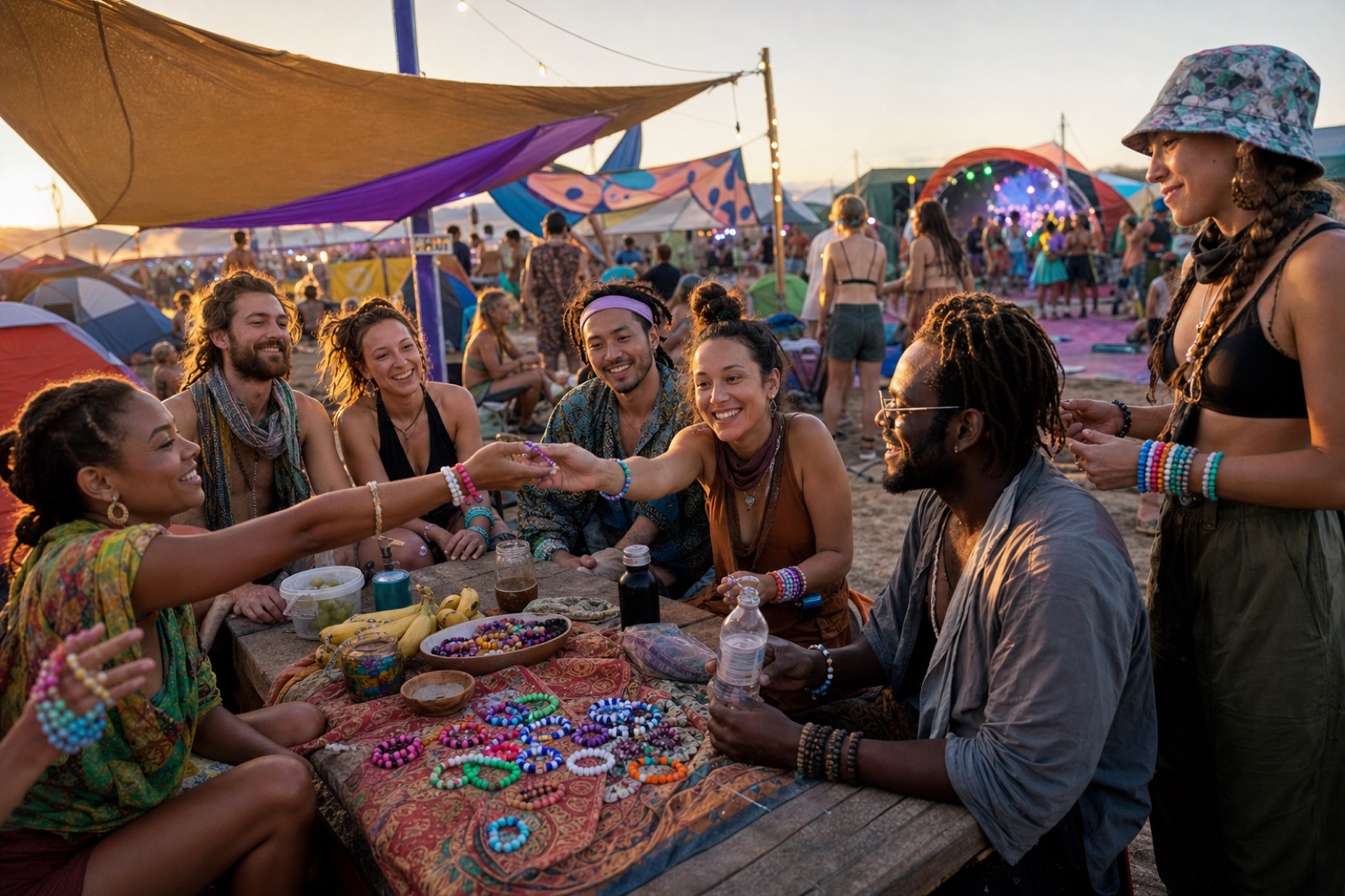
Kandi is handmade jewelry strung from plastic pony beads, usually in bright colors or spelling out words and names. LA Weekly describes the most-traded piece as a single, a one-row bracelet, while cuffs are wider multi-row pieces that can take hours or even days to make. National Geographic traces kandi swapping to the early-1990s rave scene and compares it to the friendship-bracelet trading at stadium pop concerts.
Trades often happen through the PLUR handshake, a short routine that acts out each word. One common version:
- Peace: both people make a peace sign and touch fingertips.
- Love: each hand forms half a heart, and you join them into one.
- Unity: you press palms together or clasp hands.
- Respect: you lace fingers, and one person slides a bracelet from their wrist onto the other's. Then you switch roles.
- A hug often follows. It's optional, and a smile and a thank-you are just as welcome.
Kandi etiquette for your first trades
Most kandi etiquette follows from one idea: each piece is a small gift that somebody made by hand. Long-time traders describe a handful of conventions that keep swaps friendly.
Making your own is part of the culture. Pony beads and elastic cord cost very little, and many traders value a handmade single over anything bought premade.
- Look at the wrists. Bracelets on the right arm are usually up for trade; pieces on the left are keepsakes.
- Talk first. Walking up to a stranger just to ask for kandi comes across as taking. A conversation or a shared moment is the usual lead-in.
- Accept what you're offered. Asking for a specific piece is considered rude unless the other person invites you to choose.
- Keep what you receive. Re-trading a bracelet someone gave you, especially one made for you, is widely seen as bad form.
- No kandi yet? Trade something small, or simply say thanks. Plenty of people happily give a newcomer their first piece.
- Take no for an answer. Some people don't trade or have run out, and that's fine.
Dance-floor etiquette: space, totems and photos
Crowds at big sets get tight, so small habits matter. Leave room for people who are dancing, and don't shove toward the rail mid-set. If you need to get through, say so, move in single file and keep backpacks close to your body. Spin and flow performers need a wide circle, so give them an open edge of the crowd where nobody will walk into a prop.
Totems, the signs and flags on poles that help groups find each other, come with rules that change from event to event. EDC Las Vegas caps totems at 10 feet, requires lightweight materials such as foam or PVC, and limits poles to one inch in diameter. Electric Forest sets a 7-foot maximum and bars threatening messages. Wherever you go, lower your totem during sets so the people behind you can see the stage.
Phones are part of the scene, but filming strangers up close or posting people who didn't agree to it costs them something. Ask before photographing someone's outfit or face, skip the flash in a dark crowd, and put the phone down for at least part of each set.
Consent on the dance floor
Respect in PLUR covers bodies as well as feelings. Hugs, dancing close, touching someone's outfit or kandi, and lifting someone onto your shoulders all need a clear yes first. A friendly crowd doesn't change that, and neither does a costume. If someone steps back, looks away or stops dancing with you, take it as a no.
When you see a person getting unwanted attention, RAINN's bystander guide suggests four low-risk moves it calls CARE. Create a distraction, such as inviting the person to go get water with you. Ask them directly and quietly whether they want help. Rally others, including friends, security or festival staff. Extend support afterward by staying with them. None of it requires confronting anyone.
How do you look out for strangers at a festival?
Looking out for strangers means noticing when someone near you is struggling and connecting them with help. Check on people who are sitting alone, swaying, overheated or separated from their group. Ask simple questions, offer water or shade, and walk them to medical or festival staff when something seems wrong. Stay until help arrives.
Heat is a common problem at summer events. The National Weather Service lists cool, pale, clammy skin, a fast and weak pulse, dizziness, nausea and fainting as signs of heat exhaustion. Confusion, slurred speech or passing out point to heat stroke, which the CDC treats as a 911 emergency: move the person somewhere cool and stay with them until medical staff take over.
Many large festivals also run peer-support teams. EDC's health and wellness page describes its Ground Control staff as people to approach for assistance or if you simply need a friend, and says on-site medical care is free. When you arrive anywhere, note where the medical tents and info booths are so you can point someone there fast.
PLUR at festivals today
You'll see kandi and hear PLUR at all kinds of electronic events, from mainstage festivals and bass weekends to small campouts. At transformational gatherings, the same values tend to show up as volunteering, shared camps and participation.
Heading to your first one? Our first EDM festival guide covers tickets, earplugs and getting home safely, and the festival calendar shows what's coming up near you.
Frequently asked questions
What does PLURR mean?
PLURR adds a fifth word, Responsibility, to Peace, Love, Unity and Respect. It reminds people to take care of themselves and their friends, from drinking water to sticking with their group, so others aren't left carrying them. Both versions are common, and nobody will correct you for using either.
Is it rude to ask someone for kandi?
Walking up to a stranger just to ask for kandi is widely considered rude. Start a conversation, share a moment, or offer a piece of your own first. Plenty of people give a first bracelet to newcomers, and it means more when it comes from a real connection.
Do I have to do the PLUR handshake to trade kandi?
No. The handshake is a tradition that many traders enjoy, but a simple swap and a thank-you works too. If someone offers the handshake and you don't know the steps, say so. Most people are happy to walk a first-timer through it.
Can I bring a totem to a festival?
Often, with limits. EDC Las Vegas caps totems at 10 feet and requires lightweight materials, while Electric Forest sets a 7-foot maximum and bars threatening messages. Rules differ between events, so read your festival's allowed and prohibited items list before you build one.
Sources
- VICE (Thump): How Frankie Bones' Storm Rave Birthed the PLUR Movement2015 history built on interviews with Frankie Bones and Adam X: the July 4, 1990 train-car painting, the PLUM-to-PLUR evolution, Bones repeating the motto on the mic, and the final Storm Rave in December 1992.
- LA Weekly: Inside the World of the Kandi Kids, Dance Music's Most Colorful SubcultureSingles versus cuffs, cuffs taking hours or days to make, the custom of not re-trading received pieces, distaste for premade kandi, and the account crediting Frankie Bones at a 1993 Bronx rave.
- Wikipedia: PLURSummary of competing origin accounts, including the 1993 Brooklyn Storm Rave version and differing credit for adding Respect; the PLURR variant.
- National Geographic: Unweaving the history of friendship braceletsKandi bracelets emerging and being swapped at raves in the early 1990s, and the comparison with friendship-bracelet trading at pop concerts.
- Wikipedia: Kandi braceletSteps of the PLUR handshake used in kandi trades and the right-arm/left-arm trading convention.
- EDM Identity: Kandi Etiquette: The Guide To Trading For First TimersTrading conventions: right arm for trading, left arm off-limits, make a connection before asking, don't request specific pieces, don't re-trade gifts, trade something else if you have no kandi; the PLURR variant.
- EDC Las Vegas: Hours & InfoTotem rules: 10-foot maximum, lightweight materials, poles no thicker than one inch.
- Electric Forest: Festival Info & PoliciesTotem rules: no taller than 7 feet, light materials, no threatening messages.
- RAINN: Stop Sexual Violence: Step In With CAREThe CARE bystander steps: create a distraction, ask directly, rally others, extend support.
- National Weather Service: Heat Cramps, Exhaustion, StrokeWarning signs of heat exhaustion and heat stroke.
- CDC: Heat-related IllnessesHeat stroke symptoms and first aid: call 911, move the person to a cool, shaded area, stay with them.
- EDC Las Vegas: Health & WellnessGround Control staff available for assistance or if you need a friend; free on-site medical care.
Written and checked by the EDMber editors. Festival dates come from official festival sites and are re-checked monthly. How we research and correct articles.