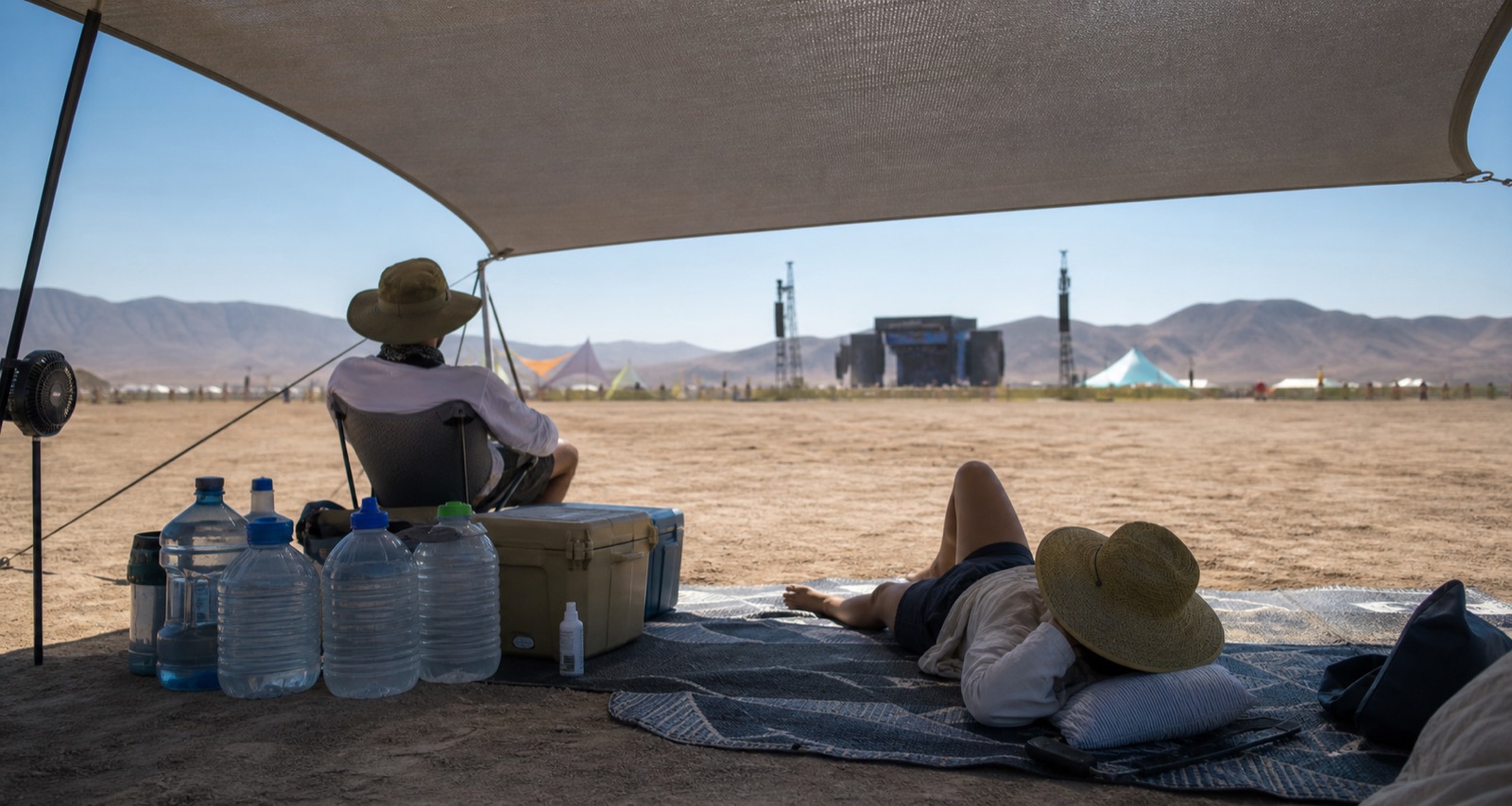
How to Handle the Heat at Desert Festivals
Handle desert festival heat by planning your day around it: rest in shade through the afternoon, sip water steadily and add an electrolyte drink when you sweat for hours, and wear sunscreen, a brimmed hat and loose, light clothing. Learn the signs of heat exhaustion and heat stroke, which is a 911 emergency. Pack goggles, a dust mask and a warm layer, because desert nights cool fast.
Typical temperatures at four desert festivals
A desert festival day can hold two climates: a hot, dry afternoon and a cool night. The table uses NOAA's 1991–2020 climate normals from the weather station nearest each site. These are long-term monthly averages, not a forecast, and a heat wave can push any weekend well past them. In the days before you travel, check the local forecast and the National Weather Service HeatRisk map, which rates the heat danger for each day.
Each event meets the heat in its own way. EDC Las Vegas starts in the late afternoon or evening and runs until 5:30 a.m., so the full daytime high mostly falls on people camping at Camp EDC or arriving early. Splash House works the other way round, with daytime pool parties at three Palm Springs resorts in one of the hottest months of the year and after-hours events at night. Coachella in April averages a high in the mid-80s, mild by desert standards, though long afternoons on open polo fields still add up.
Burning Man is the harshest of the four. The organizer's survival guide says daytime temperatures on the playa routinely exceed 100°F with extremely low humidity, which is hotter than the August average at the Gerlach station. Averages smooth out the hot years, so plan for the high end. More events in the state are listed on the Nevada festival page.
| Festival | Where | Month | Nearest NOAA station | Average high | Average low |
|---|---|---|---|---|---|
| Coachella | Empire Polo Club, Indio, CA | April | Indio Fire Station | 85.8°F | 63.1°F |
| EDC Las Vegas | Las Vegas Motor Speedway, NV | May | North Las Vegas | 89.4°F | 63.9°F |
| Splash House | Palm Springs, CA | August | Palm Springs | 107.5°F | 78.8°F |
| Burning Man | Black Rock Desert, NV | Late August to early September | Gerlach, NV | 93.0°F (Aug), 83.9°F (Sep) | 58.9°F (Aug), 49.3°F (Sep) |
How do you spot heat exhaustion and heat stroke?
Heat exhaustion shows up as heavy sweating, weakness, cool and clammy skin, a fast, weak pulse, nausea, dizziness or a headache. Heat stroke is more dangerous: confusion, slurred speech, hot red skin that may be dry or damp, and a body temperature above 103°F. It is a medical emergency, so call 911 or get festival medical staff right away.
The National Weather Service and CDC describe three stages, and the response changes with each one:
- Heat cramps: painful cramps, usually in the legs or abdomen, along with heavy sweating. NWS says cramps can be the first sign of heat illness. Stop, get into shade and sip water unless you feel nauseated. CDC suggests a carbohydrate-electrolyte drink and advises against salt tablets. Get medical help if the cramps last more than an hour.
- Heat exhaustion: move to a cooler place, ideally an air-conditioned medical tent, loosen clothing, apply cool wet cloths and take sips of water. NWS says to get medical attention right away if the person vomits or if symptoms get worse or last longer than an hour.
- Heat stroke: call 911 or flag down medical staff, move the person somewhere cooler and cool them quickly with cool water, wet cloths or ice while you wait. NWS advises against giving fluids to someone with heat stroke. CDC warns that body temperature can reach 106°F or higher within 10 to 15 minutes, so never wait to see whether it passes.
Getting help for heat illness on site
Large festivals staff free first aid. EDC's health page, for example, says its medical teams care for people free of charge and asks anyone who feels lightheaded or nauseated to visit a first aid tent or stop a member of its health and safety team. Find the medical tents on the map when you arrive, and walk a friend there at the first sign of trouble.
Use a buddy system so someone notices when you start slurring, stumbling or wandering off. Confusion is one of the signs of heat stroke, so the person who needs help may not be the one who asks for it. Some people also start with less margin. NWS lists people with chronic medical conditions, people who take certain medications and pregnant women among those at higher risk in extreme heat, so if that is you, talk to a doctor before a desert trip.
How much water should you drink at a desert festival?
Drink steadily, before you feel thirsty, instead of in big gulps. CDC's guidance for people working in the heat is about one cup (8 ounces) of water every 15 to 20 minutes during moderate activity, and generally no more than six cups an hour. If you sweat for several hours, CDC recommends sports drinks with balanced electrolytes as well.
That guidance was written for outdoor workers, and a long day on your feet in full sun is a reasonable comparison. The hourly cap matters as much as the minimum, because more is not always better. Skip salt tablets unless a doctor has told you to take them; both CDC and the NIH's MedlinePlus advise against them.
Watch your own signals. MedlinePlus lists thirst, a dry or sticky mouth, not urinating much, darker yellow urine, headache and muscle cramps as signs of mild to moderate dehydration. Confusion, dizziness, a racing heart, fast breathing or fainting point to severe dehydration or heat illness and need medical help. CDC also recommends avoiding alcohol and drinks high in caffeine or sugar when you are working in the heat.
Plan your supply before you go. Burning Man asks participants to bring 1.5 gallons of water per person per day for drinking, washing and cleaning, since everyone must bring their own. Many festivals run refill stations, including EDC Las Vegas, where they are free, and Splash House, which bans metal bottles, so read each event's container rules before you pack. Our festival camping checklist covers carrying and storing water at camp.
Shade, rest and pacing through the afternoon
The National Weather Service's first piece of advice for extreme heat is to slow down and move strenuous activity to the coolest part of the day. At a festival, that means treating early afternoon as downtime: shade, food, water and rest, then back to the dance floor once the sun drops. CDC puts it simply: stay in the shade as much as possible when you are outside for long periods.
Bring or build shade. Burning Man's guide recommends shade structures, umbrellas or parasols and suggests laying low during the hottest part of the day. If you camp, put a shade canopy over your living space, stake it for wind and set chairs underneath so resting is easy. Use the tent for sleeping and the shade for daytime.
Give your body time to adjust. CDC's guidance for workers builds up heat exposure gradually over 7 to 14 days, and Burning Man notes that nearly everyone needs a day or so to adapt to the desert climate. A weekend trip from somewhere cooler leaves little time to acclimatize, so keep the first afternoon light.
Cool down on purpose. NWS recommends a cool shower or bath, and cool wet cloths on the skin help too. Battery fans lose their value as the temperature climbs: NWS warns that blowing air at someone can make them hotter once the heat index is above the 90s.
Sun protection and clothing for desert heat
Sunburn makes heat harder to handle, because, as NWS notes, it reduces your body's ability to get rid of heat. CDC recommends a broad-spectrum sunscreen of SPF 15 or higher, reapplied after two hours in the sun and after swimming, sweating or toweling off. Add a hat with a brim all the way around and sunglasses that block both UVA and UVB. CDC says UV rays are strongest from 10 a.m. to 4 p.m.
Elevation raises the dose. Black Rock City sits at nearly 4,000 feet, and Burning Man's guide warns that skin burns faster and more severely there than at lower elevations, so apply sunscreen every morning and again as needed. Lip balm and lotion help in the dry air.
For clothing, NWS recommends lightweight, loose-fitting, light-colored fabric to reflect heat and sunlight, and CDC adds that tightly woven fabric gives the best sun protection. EDC's health page makes the same point about costumes: if you wear heavy fabrics or faux fur, drink more. It also recommends comfortable sneakers over sandals and flip-flops. On the alkaline playa, Burning Man's medical guidance describes playa foot and suggests a daily 20-minute soak in a four-to-one water-to-vinegar mix, followed by lotion and socks.
Dust storms: goggles, masks and driving safely
Desert wind can turn a clear afternoon into a whiteout. Burning Man's survival guide says dust storms can produce instant whiteouts, with gusts that can exceed 75 mph, and it lists goggles and a particle or dust mask among the items every participant must bring. When the wind comes, it advises taking shelter at once. If you are far from shelter, sit down, turn your back to the wind, cover your face and wait it out.
Pack goggles that seal around your eyes and a dust mask, with a bandana as a backup. Contact lens wearers should carry glasses and lens supplies; Burning Man's checklist suggests disposable lenses. Bring any prescriptions you rely on in their original containers, and if you use an inhaler, keep it on you.
Dust is also a hazard on the drive in and out. If dense dust blows across the road, NWS advises pulling off the pavement as far as you can, stopping, turning off your lights, setting the parking brake and taking your foot off the brake pedal, so drivers behind you don't follow your taillights off the road. Burning Man tells drivers inside the event to stop and wait for a whiteout to pass.
Why desert nights get cold after a hot day
Desert heat rarely lasts the night. Burning Man's guide says temperatures can fall 50 degrees once the sun goes down and that overnight lows can be in the 40s, and it tells participants to bring warm clothing and a good sleeping bag. NOAA's normals show the same swing: Gerlach's average September day runs from 83.9°F down to 49.3°F.
Other desert sites swing widely too. Joshua Tree Music Festival, a campout in the Mojave held each May and October, sits near a station where the average May high is 86.1°F and the average low is 53.6°F. After a day of sweating, a night in the 50s in damp clothes is colder than it sounds; CDC notes that hypothermia can occur above 40°F when someone is chilled by rain or sweat.
Pack a warm layer for after dark, a hat, dry socks and a sleeping bag rated for the low, and change out of sweaty clothes before you sleep. For layering and sleeping bag ratings, see how to stay warm on cold festival nights. First-timers can find the rest of the packing list in our first EDM festival guide.
Frequently asked questions
What are the first signs of heat illness at a festival?
Muscle cramps, heavy sweating, headache, dizziness, nausea and unusual tiredness are common early signs, according to CDC and the National Weather Service. Stop, get into shade, sip water and cool off. Confusion, slurred speech or a body temperature above 103°F suggest heat stroke, which needs 911 or festival medical staff at once.
Is water enough, or do I need electrolytes?
Water covers most of a festival day. CDC suggests sports drinks with balanced electrolytes once heavy sweating lasts several hours, and advises against salt tablets. Sip about a cup every 15 to 20 minutes while you are active in the heat, and stay under roughly six cups an hour.
Do I really need goggles and a dust mask?
At a playa event like Burning Man, yes. The organizer's survival guide lists goggles and a particle or dust mask as items every participant must bring, because dust storms can cause sudden whiteouts. For other desert festivals, check the forecast for wind, and pack both if strong gusts or blowing dust are expected.
How cold does it get at night at desert festivals?
Colder than many people pack for. NOAA's normals put Gerlach, the town nearest Burning Man, at an average September low of 49.3°F, and the event's guide says lows can be in the 40s. Joshua Tree averages 53.6°F on May nights. Bring a warm layer and a sleeping bag rated for the low.
Sources
- National Weather Service: Heat Cramps, Exhaustion, StrokeSymptoms and first aid for heat cramps, heat exhaustion and heat stroke, including the 103°F threshold, calling 911, not giving fluids in heat stroke, the one-hour rule, and fans making people hotter above the 90s.
- CDC NIOSH: Heat-related IllnessesHeat stroke signs and first aid (body temperature can reach 106°F or higher within 10 to 15 minutes; call 911; cool quickly); heat cramps treated with water and a carbohydrate-electrolyte drink, avoiding salt tablets.
- CDC NIOSH: Workplace Recommendations (Heat Stress)One cup (8 oz) of water every 15–20 minutes for moderate activity, no more than six cups an hour, sports drinks with balanced electrolytes for several hours of sweating, avoiding alcohol and high-caffeine or high-sugar drinks, and acclimatizing over 7 to 14 days.
- CDC: About Heat and Your HealthOverheating symptoms and the advice to stay in the shade as much as possible and carry water.
- National Weather Service: During a Heat WaveSlowing down and moving strenuous activity to the coolest time of day, lightweight loose light-colored clothing, sunburn reducing the body's ability to dissipate heat, drinking before thirst, no salt tablets unless prescribed, and cool showers.
- National Weather Service: Heat Safety Tips and ResourcesHigher heat risk for people with chronic medical conditions, people taking certain medications and pregnant women.
- NIH MedlinePlus: DehydrationSigns of mild, moderate and severe dehydration, water or electrolyte sports drinks for treatment, no salt tablets, and when to call 911.
- CDC: Sun Safety FactsBroad-spectrum SPF 15+ sunscreen, reapplying after two hours and after sweating, wide-brimmed hats, UVA/UVB sunglasses, tightly woven fabric, and UV peaking from 10 a.m. to 4 p.m.
- National Weather Service: Dust Storms and HaboobsWhat drivers should do when dense dust crosses a road: pull off, stop, lights off, parking brake on, foot off the brake.
- NOAA Weather Prediction Center: NWS HeatRiskDaily heat-risk forecast map to check before travel.
- NOAA NCEI: 1991–2020 monthly normals, Indio Fire Station, CA (USC00044259)April average high 85.8°F and low 63.1°F used for Coachella.
- NOAA NCEI: 1991–2020 monthly normals, North Las Vegas, NV (USC00265705)May average high 89.4°F and low 63.9°F used for EDC Las Vegas.
- NOAA NCEI: 1991–2020 monthly normals, Palm Springs, CA (USC00046635)August average high 107.5°F and low 78.8°F used for Splash House.
- NOAA NCEI: 1991–2020 monthly normals, Gerlach, NV (USC00263090)August (93.0°F / 58.9°F) and September (83.9°F / 49.3°F) average highs and lows used for Burning Man.
- NOAA NCEI: 1991–2020 monthly normals, Joshua Tree, CA (USC00044405)May average high 86.1°F and low 53.6°F used for Joshua Tree Music Festival.
- Burning Man Survival Guide: SurvivalPlaya daytime highs routinely above 100°F, elevation near 4,000 feet and faster sunburn, 50-degree drops after sunset with lows in the 40s, 1.5 gallons of water per person per day, shade, required goggles and dust mask, whiteouts with winds above 75 mph, and what to do in one.
- Burning Man Survival Guide: HealthPlaya foot and the 4:1 water-to-vinegar soak.
- EDC Las Vegas: Hours & InfoLas Vegas Motor Speedway location and evening-to-5:30 a.m. festival hours.
- EDC Las Vegas: Health & WellnessFree water refill stations, free medical care, the buddy system, and clothing advice for heat.
- Splash House: HomeTwo weekends of daytime pool parties at three Palm Springs resorts, with night events at the Palm Springs Air Museum.
- Splash House: FAQsAugust weekend timing, water refill stations at each host hotel and the Air Museum, and the 21+ age policy.
- Splash House: Festival InfoMetal water bottles are on the prohibited items list.
- Coachella: FAQApril festival at the Empire Polo Club in Indio.
- Joshua Tree Music FestivalCampout festival in the Mojave held every May and October.
- Burning Man Project: Black Rock CityBlack Rock City is held in Nevada's Black Rock Desert from late August into early September.
Written and checked by the EDMber editors. Festival dates come from official festival sites and are re-checked monthly. How we research and correct articles.