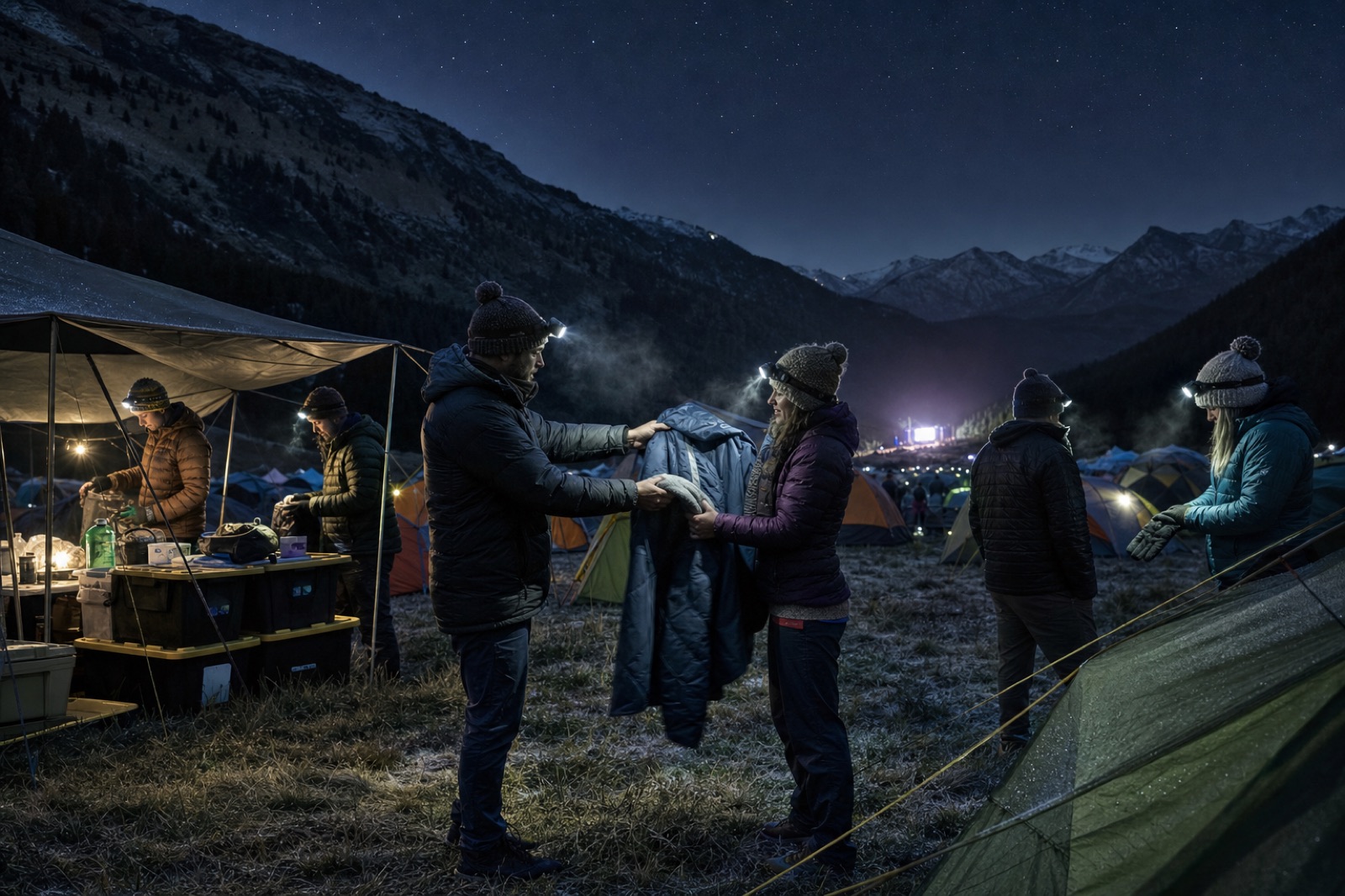
How to Stay Warm at Festivals on Cold Nights
Staying warm at a festival comes down to three habits. Dress in layers you can add and shed: a wool or synthetic base, an insulating middle and a wind- and rain-proof shell. Sleep on an insulated pad in a bag rated for the expected low. And stay dry, because hypothermia can set in above freezing when you are wet and tired.
Festivals where the nights run cold
Cold festival nights usually come from elevation, latitude or season. Organizers of high-desert and mountain events say so directly: Burning Man's survival guide warns that temperatures can drop 50 degrees after sunset, and Apogaea tells campers to prepare for hot days and cold nights. The table uses long-term climate normals from the nearest weather station that publishes them. They describe a typical night in that month, not a forecast.
Averages hide the cold snaps. Burning Man's guide says overnight lows on the playa can be in the 40s. In Colorado, Apogaea puts typical June highs at 85 to 90 degrees with lows of 50 to 55, and its survival guide reminds campers that rain, snow and hail are all possible in the mountains. Northern summer festivals such as Shambhala and Bass Coast in British Columbia average lows in the low 50s in July, and you can find more on the British Columbia festival page.
A night in the 50s sounds mild until you are damp from dancing, standing in wind or lying on cold ground. CDC notes that hypothermia can happen above 40°F when someone is chilled by rain, sweat or cold water, and the National Weather Service says it can occur at temperatures as warm as 60°F for people outdoors for a long time without the right clothing.
| Festival | Where | Month | Nearest station with normals | Average high | Average low |
|---|---|---|---|---|---|
| Burning Man | Black Rock Desert, NV | Late August to early September | Gerlach, NV (NOAA 1991–2020) | 93.0°F (Aug), 83.9°F (Sep) | 58.9°F (Aug), 49.3°F (Sep) |
| Electric Forest | Double JJ Resort, Rothbury, MI | June | Hart 3 WSW, MI (NOAA 1991–2020) | 76.1°F | 53.6°F |
| Shambhala Music Festival | Salmo River Ranch, BC | July | Castlegar Airport, BC (ECCC 1981–2010) | 82.5°F (28.1°C) | 53.9°F (12.2°C) |
| Bass Coast | Merritt, BC | July | Merritt, BC (ECCC 1981–2010) | 80.1°F (26.7°C) | 51.4°F (10.8°C) |
| Igloofest | Old Montreal, QC | January to early February | Montréal-Trudeau Airport (ECCC 1981–2010) | 22.5°F (−5.3°C) in Jan | 6.7°F (−14.0°C) in Jan |
How should you layer for a cold festival night?
Wear three layers you can adjust: a wool or synthetic base layer against your skin, an insulating middle layer such as fleece, wool or a puffy jacket, and a windproof, ideally waterproof shell on top. Add a warm hat, mittens or gloves and wool socks. Skip cotton, which stops keeping you warm once it gets wet.
Adjustability is the point. The National Park Service recommends adjustable layers to prevent both overheating and chilling, with a windproof, hooded outer layer over wool or synthetic insulation. NWS says to remove layers before you overheat and sweat, because damp clothing chills you later. That matters at a festival, where you may dance hard for an hour and then stand still in the wind between sets. Take the middle layer off while you dance and put it back on as soon as you stop.
Cover your hands, feet and head. NWS notes that mittens are better than gloves and recommends a warm hat, and CDC's cold-stress guidance for workers also calls for a hat and several layers of loose clothing. Keep a dry pair of socks in a pocket or day bag. When a costume is the plan for the night, wear a base layer under it and carry a packable insulated jacket and a shell that fit over the top.
Sleeping bag temperature ratings, explained
Sleeping bag ratings come from a standardized EN/ISO test, and the number on the label is easy to misread. Therm-a-Rest's guide to the system explains that each rating is split into three ranges: a comfort range, where a sleeper should feel warm; a transition range, whose lower edge is the official rating printed on the bag; and a risk range below that, which is dangerous outside an emergency.
So on a bag labeled 20°F, the printed number is the bottom of the transition range, and most people reach the bag's limit somewhere above it. Warm sleepers may be comfortable near the rating, while cold sleepers may be fighting the cold well above it. Choose a bag whose comfort range covers the coldest night you expect. Therm-a-Rest adds that your pad, your base layers and what you have eaten all change how warm a bag feels.
You can get more warmth out of the bag you already own. Eric Larsen's sleeping-warm tips on the Therm-a-Rest blog start with staying dry: change into completely dry clothes before bed, zip the bag all the way and cinch the hood on very cold nights. He also suggests wearing a hat, keeping a snack within reach for the middle of the night and using the bathroom before sleep, so your body is not spending energy keeping a full bladder warm. A quilt or blanket laid over the bag adds warmth too.
Why your sleeping pad matters on cold ground
The ground is a bigger drain than the air. Larsen writes that you lose far more heat through direct contact with cold ground than to the air around you, and Therm-a-Rest explains that a sleeping bag's insulation does little underneath you because your weight compresses it. Insulation from the ground deserves as much thought as the bag.
Pads are rated by R-value, a measure of thermal resistance: the higher the number, the better the pad insulates. The standard test is ASTM F3340, which measures a camping mattress between a heated plate and a cold plate so different pads can be compared. ASTM notes that the lab figure will not always match real-world performance, because edge heat loss, compression and sleeping posture all change the result.
For festival camping, check the R-value before you trust a pad on a cold night. A big inflatable air bed that lists no R-value should not be your only insulation, so put a closed-cell foam pad or a folded blanket underneath it. Therm-a-Rest notes that layering a closed-cell foam pad under an inflatable pad boosts the overall R-value. Top off an air mattress in the evening, too; Larsen points out that the air inside cools and shrinks after dark. The festival camping checklist covers the rest of a sleep setup.
What are the warning signs of hypothermia?
CDC lists shivering, exhaustion or feeling very tired, confusion, fumbling hands, memory loss, slurred speech and drowsiness as warning signs of hypothermia in adults. A body temperature below 95°F needs medical attention immediately. At a festival, get the person to the medical tent or call 911, and start warming them while help is on the way.
CDC's first aid steps while you wait:
- Move the person to a warm, sheltered place, such as a heated medical area, and remove any wet clothing.
- Warm the center of the body first: chest, neck, head and groin. Use an electric blanket if one is available, or skin-to-skin contact under loose, dry layers of blankets, clothing or towels.
- Offer warm drinks only if the person is fully conscious, and never alcohol.
- Once their body temperature has risen, keep them dry and wrapped in a warm blanket, including the head and neck.
- If the person is unconscious and seems to have no pulse or breathing, call for emergency help and begin CPR, and keep warming them while you do.
What raises hypothermia risk at a festival
Alcohol is one factor. NWS points out that it reduces shivering, one of the body's ways of warming itself, and CDC counts drinking among the risk factors for hypothermia. Being wet is another, whether from rain, sweat or a late swim, and so is spending long hours outdoors, which CDC also lists.
A long weekend with little sleep also makes the early signs easy to dismiss as ordinary tiredness, since exhaustion and drowsiness are on CDC's list. Watch your friends as well as yourself, because confusion and drowsiness make the signs hard to notice in your own body. If someone is shivering hard, slurring or unusually sleepy, get them somewhere warm and tell medical staff.
Setting up camp for a cold night
Pack for the coldest night in the forecast. Burning Man's checklist includes warm clothing, rain gear, and warm sleeping bags and bedding, and Apogaea's guide asks campers to bring weather-appropriate clothing and shelter that protects from sun, rain and cold.
Eat and drink well. NWS notes that food gives the body energy to produce its own heat and that cold air is very dry, so keep drinking water and other non-alcoholic, non-caffeinated drinks. The National Park Service adds that the harder your body works to stay warm, the more you need to eat and drink. NWS also suggests hot food and warm drinks several times a day.
Never run a generator, fuel heater or stove inside a tent or closed car. NWS advises running portable generators outdoors and at least 20 feet from doors and windows to avoid carbon monoxide poisoning. Rely on extra blankets and chemical hand warmers, which CDC suggests keeping in a cold-weather first aid kit. Store tomorrow's base layer and socks in a dry bag so they stay dry overnight.
Winter festivals: dancing outside in freezing cold
Igloofest is held outdoors in Old Montreal in January and early February, when the average January low at Montréal-Trudeau Airport is −14°C (6.7°F). Igloofest is a city event, but hours outside at those temperatures bring frostbite into play as well as hypothermia. Other winter events appear on the January festival calendar.
Know the early signs. NWS, citing CDC, says redness or pain in any skin area may be the first sign of frostbite, followed by a white or grayish-yellow patch, skin that feels unusually firm or waxy, or numbness. Get indoors, don't rub the area, and rewarm it with warm, not hot, water. NWS says to go to a hospital as soon as possible if the skin turns blue or gray, swells badly, blisters, or feels hard and numb.
Dress for standing still in the cold. NWS advises covering every part of your body, choosing mittens over gloves, keeping your skin dry and staying out of the wind when you can, and CDC's cold-stress guidance calls for waterproof, insulated boots. Take regular warm-up breaks indoors. NWS also warns that alcohol reduces shivering and that caffeine constricts the blood vessels that keep your hands and feet warm.
Frequently asked questions
What temperature sleeping bag do I need for Burning Man?
Plan for nights in the 40s. NOAA's normals put nearby Gerlach's average September low at 49.3°F, and the organizer's guide says playa lows can be in the 40s. Choose a bag whose comfort range covers the 40s or lower, sleep on an insulated pad, and pack a hat and a dry base layer.
Can you get hypothermia when it isn't freezing?
Yes. CDC says hypothermia can happen above 40°F if someone is chilled by rain, sweat or cold water, and the National Weather Service notes it can occur at temperatures as warm as 60°F. Wet clothes, wind, exhaustion and alcohol all raise the risk, so staying dry matters as much as warm layers.
Is an air mattress warm enough for festival camping?
Often not on its own. Cold ground pulls heat from your body, and many large air beds list no R-value, the standard measure of pad insulation. Put a closed-cell foam pad or blanket underneath, top up the air in the evening as it cools, and use a sleeping bag rated for the low.
Should I sleep in my festival clothes?
Change first. Eric Larsen's advice on the Therm-a-Rest blog is to start the night in completely dry clothes, because sweat and damp fabric pull heat away from your body. Sleep in a clean base layer and socks, add a hat or another layer if you get cold, and avoid getting so warm that you sweat.
Sources
- CDC: Preventing HypothermiaAdult warning signs of hypothermia, the 95°F threshold, first aid steps (warm shelter, remove wet clothing, warm the center first, warm non-alcoholic drinks if conscious, CPR), risk factors including alcohol and long hours outdoors, and hypothermia above 40°F when chilled by rain, sweat or cold water.
- National Weather Service: During Extremely Cold WeatherHypothermia below 95°F and at air temperatures as warm as 60°F, alcohol reducing shivering, caffeine constricting blood vessels, mittens over gloves, frostbite signs and first aid citing CDC, hot food and warm drinks, and running generators at least 20 feet from doors and windows.
- National Weather Service: What To Do If You're Caught in a Winter StormLoose layers, removing layers to avoid sweating and later chill, food as fuel for body heat, and staying hydrated in dry cold air.
- National Park Service (Yellowstone): Winter SafetyAdjustable layers, a windproof hooded outer layer over wool or synthetic insulation, avoiding cotton because it does not keep you warm when wet, wool socks, and eating and drinking more in the cold.
- CDC NIOSH: Cold StressSeveral layers of loose clothing, a hat, waterproof insulated boots, warm breaks, and chemical hot packs in the first aid kit.
- Therm-a-Rest: The Ultimate Guide to Sleeping Bags & QuiltsEN/ISO comfort, transition and risk ranges, the listed rating as the bottom of the transition range, and how pads, base layers and diet affect warmth.
- Therm-a-Rest: What Is R-Value?R-value as thermal resistance (higher insulates better), conductive heat loss to the ground, and compressed insulation underneath a sleeper.
- ASTM International: F3340 Standard Test Method for Thermal Resistance of Camping MattressesThe standard hot-plate test for pad R-value and its note that lab values may not match real-world performance.
- Therm-a-Rest: Eric Larsen's Tips for Sleeping WarmStaying dry, zipping and cinching the bag, wearing a hat, insulating from the ground, re-inflating air pads in the evening, eating, and using the bathroom before sleep.
- Therm-a-Rest: 4 Winter Camping Safety Tips for All Skill LevelsLayering a closed-cell foam pad under an inflatable pad to raise overall R-value, and adding a quilt over a sleeping bag.
- NOAA NCEI: 1991–2020 monthly normals, Gerlach, NV (USC00263090)August and September average highs and lows used for Burning Man.
- NOAA NCEI: 1991–2020 monthly normals, Hart 3 WSW, MI (USC00203632)June average high 76.1°F and low 53.6°F used for Electric Forest.
- Environment and Climate Change Canada: Canadian Climate Normals1981–2010 normals for Castlegar A (climate ID 1141455, July 28.07°C / 12.18°C), Merritt STP (1125079, July 26.72°C / 10.76°C) and Montréal-Trudeau International (7025250, January −5.29°C / −14.04°C).
- Burning Man Survival Guide: Survival50-degree drops after sunset, overnight lows in the 40s, and the checklist of warm clothing, rain gear and warm bedding.
- Apogaea: Survival Guide & Event ChecklistTypical June highs of 85–90 degrees and lows of 50–55 in the Colorado mountains, and the possibility of rain, snow and hail.
- Shambhala Music FestivalJuly festival at the Salmo River Ranch in British Columbia.
- Bass CoastJuly festival in Merritt, British Columbia.
- Electric Forest: Festival InfoJune festival at the Double JJ Resort in Rothbury, Michigan.
- IgloofestOutdoor winter festival in Old Montreal running from January into early February.
Written and checked by the EDMber editors. Festival dates come from official festival sites and are re-checked monthly. How we research and correct articles.