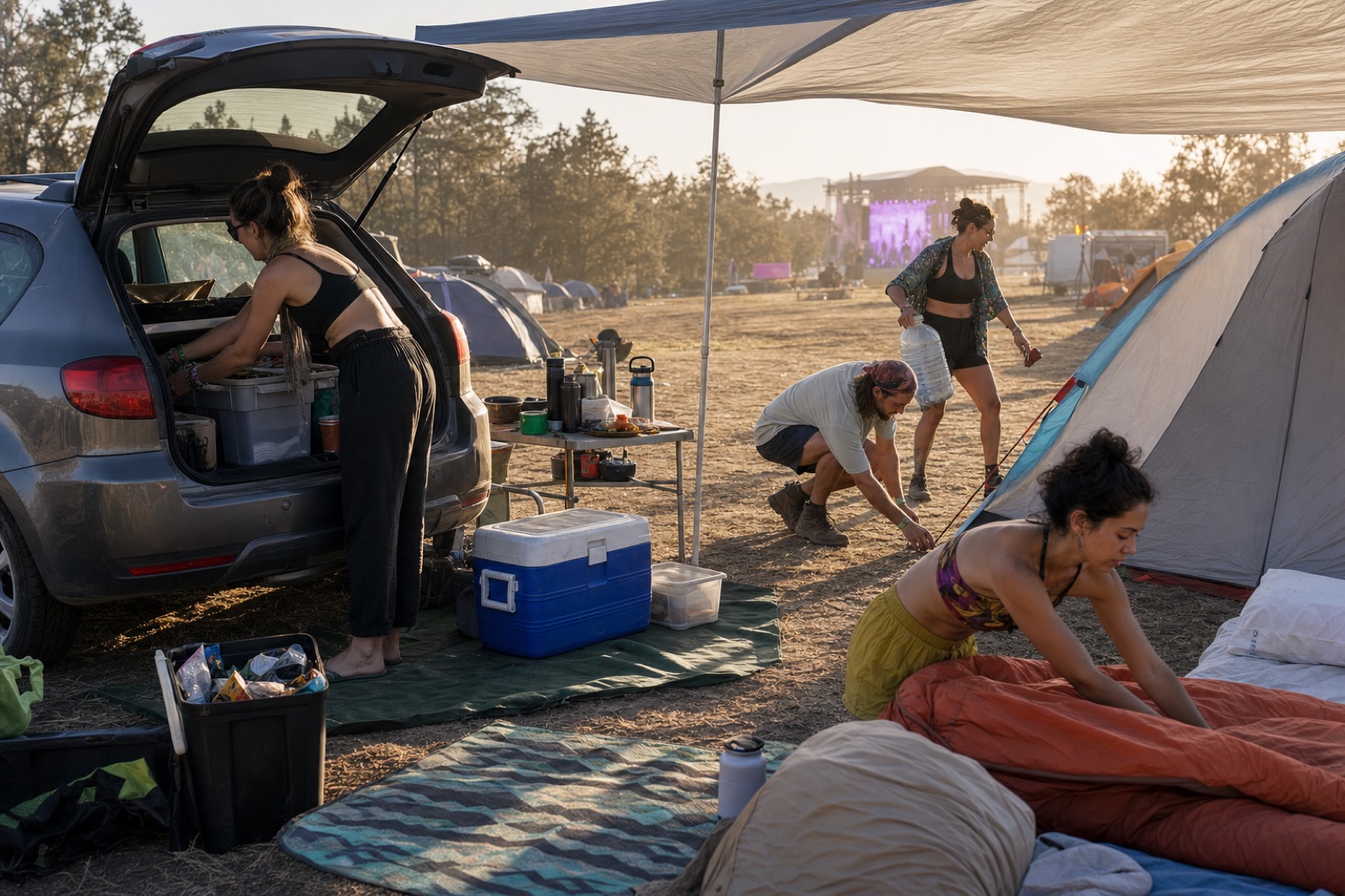
Festival Camping Checklist: What to Pack
Pack for festival camping by category: a tent and shade that can handle wind and rain, a sleep setup warm enough for cold nights, water containers and a cooler, simple food, battery power, layers, and a first aid kit. Then read your festival's camping rules, because glass, gas generators and open flames are banned at many events and the details vary.
Car camping or walk-in tent camping?
With car camping you park beside your site, so you can bring a cooler, a canopy and more comfort, though it usually costs extra. Walk-in tent camping is often included with the ticket and means carrying everything from the parking lot, sometimes a long way. Choose based on your group size, budget and how much you can haul.
Pricing models differ a lot. Coachella sells car camping per vehicle, and its 30-by-10-foot sites allow, in the festival's words, unlimited friends and tents if they fit. Electric Forest sells camping passes per vehicle or tent site, not per person. Shambhala includes free tent camping and parking with each ticket and charges extra to camp with a vehicle. Every three-day pass at Infrasound includes camping, with car camping sold as an add-on, and Lost Lands sells camping separately from its GA and VIP passes.
Walk-in campers should pack as if everything has to arrive in one trip. The prep guide for Electric Forest puts it simply: only take what you can carry. A collapsible wagon helps if your festival allows one.
The festival camping checklist at a glance
Use the table as a packing list, then trim it to fit your car or your back. Items marked “if allowed” are the ones most likely to run into a festival's rules.
| Category | Pack | Notes |
|---|---|---|
| Shelter | Tent with rainfly, extra stakes, mallet, footprint or tarp, canopy or shade cloth (if allowed) | Stake everything; open campgrounds catch wind |
| Sleep | Sleeping bag rated for the night lows, sleeping pad or air mattress, pillow, earplugs, eye mask | Campgrounds stay loud and lit late |
| Water | Refillable bottles, a large jug for camp, enough water for arrival day | Ready.gov's baseline is one gallon per person per day |
| Food | Cooler, ice, no-cook meals, snacks, camp stove and small propane canisters (if allowed), utensils, trash bags | Keep it simple and heat-proof |
| Power and light | Battery packs, short cables, headlamp or flashlight, lantern, solar charger (check glass rules) | Expect no outlets at your site |
| Clothing | Layers for cold nights, rain jacket or poncho, brimmed hat, two pairs of broken-in shoes, extra socks | Plan for the full forecast range |
| First aid and hygiene | Bandages, gauze, tape, antiseptic wipes, cold pack, sunscreen, hand sanitizer, toilet paper, personal medications | Based on the Red Cross kit list |
| Camp basics | Chairs, table, site lights, a flag or landmark, duct tape, zip ties, a small lock box for valuables | Makes your site easy to find at night |
| Leave No Trace | Trash and recycling bags, a plan to haul out everything you brought | Pack it in, pack it out |
Shelter, shade and sleep
A sensible minimum for any campsite comes from Electric Forest's prep guide: shelter that protects from rain and sun, plus folding chairs, a table or two and some lights. Shade matters as much as the tent itself. A closed tent in direct sun heats up quickly after sunrise, so put a canopy or tarp over your living space and use the tent mostly for sleeping.
Stake down everything, including the canopy, and bring spare stakes. Coachella's camping page warns that high winds and heavy dust are common in the Coachella Valley. Check the rules before you buy a shade structure: Coachella bans branded pop-up canopies and tents, for example.
Nights can be far colder than days. Temperatures at Electric Forest can swing from the mid-50s at night to 90-plus in full sun, according to its guide. A sleeping pad matters as much as the bag, because the ground pulls heat away from your body all night. For cold-weather events, see staying warm at festivals.
Water and food at camp
Many festivals provide free drinking water. Filling stations run throughout Electric Forest's campgrounds, and Coachella lists free refill stations in camping. Bring a large jug to carry water back to your site, and pack your own supply for arrival day or for small events without refill points. Ready.gov's emergency baseline of one gallon per person per day, for drinking and sanitation, is a useful starting figure.
Food works best when it needs little or no cooking: wraps, fruit, nut butter, cereal, and snacks you'll still want to eat in the heat. Cooking rules vary: Electric Forest bans grills, open flames and charcoal but allows small Coleman-style camp stoves with propane canisters up to 1 pound, while Coachella allows propane stoves in car camping. Cook outside the tent: the CDC warns never to use a portable gas camp stove indoors, because of carbon monoxide.
Keep the cooler in shade and drain meltwater daily. Coachella sells ice in its camping lots at set times; elsewhere, plan to buy ice on the way in.
Power, light and phones
Expect no outlets at your campsite. Battery packs are the simplest power source; bring enough capacity to recharge your phone at least once a day for every day you're staying, and turn on low-power mode to stretch it.
Gas generators are banned at many campgrounds. At Electric Forest, external fuel generators such as gas, diesel or kerosene units are prohibited, along with gas cans, though solar generators and RVs' built-in generators are exempt. Coachella bans gas generators outright. A battery power station or folding solar panel fills the gap, though Coachella's glass ban covers solar panels with glass, so read the fine print.
Bring a headlamp. The Electric Forest prep guide specifically recommends a flashlight over your phone's light, which drains the battery you need for finding friends. String lights or a lit flag also make your site easy to spot from the path at night.
Clothing, weather and first aid
Pack for the whole forecast: layers for cold nights, a rain jacket or poncho, and a brimmed hat and sunglasses for the day. Bring two pairs of comfortable shoes so one pair can dry out, and more socks than you think you need.
Thunderstorms are a serious hazard for campers. The National Weather Service says there is no safe place outside when thunderstorms are in the area, and that substantial buildings and hard-topped vehicles are the safe options. A tent or canopy offers no protection. Wait 30 minutes after the last thunder before heading back out.
For first aid, the Red Cross recommends a kit with adhesive bandages, gauze pads, adhesive tape, antiseptic wipes, antibiotic ointment, an instant cold compress, an emergency blanket, tweezers and nonlatex gloves, plus any personal medications. Add blister care and sunscreen; the CDC recommends broad-spectrum SPF 15 or higher, reapplied after two hours in the sun or after sweating.
What's commonly banned in festival campgrounds?
Glass, gas generators, open flames, fireworks, drones and weapons appear on many campground banned lists, but every festival writes its own rules and the details differ. Mirrors are fine at Electric Forest, while Coachella bans glass of any kind, including large mirrors and solar panels. Read your festival's current list before you pack, and again the week you leave.
Here is how two large camping festivals handle the usual suspects:
- Glass: banned at Electric Forest, where mirrors are the exception, and at Coachella, whose list covers bottles, large mirrors, containers, solar panels and lights.
- Generators: Electric Forest bans gas, diesel and kerosene generators and gas cans but exempts solar generators; Coachella bans gas generators.
- Fire: Electric Forest bans grills, open flames, candles and charcoal; Coachella bans campfires, candles and tiki torches.
- Fireworks and explosives: banned at both.
- Drones: banned at both, and Coachella adds remote-control vehicles and toys.
- Sound systems: Coachella bans amplified sound such as large speakers and DJ equipment in camping and starts its noise curfew at 1:30 a.m.
- Pets: Electric Forest asks attendees who can't leave pets at home to board them at a nearby kennel; service animals fall under its accessibility policy.
Camp etiquette and Leave No Trace
Leave No Trace's seven principles were written for the backcountry, and most carry straight over to a festival campground: plan ahead and prepare, travel and camp on durable surfaces, dispose of waste properly, leave what you find, minimize campfire impacts, respect wildlife, and be considerate of others.
In practice, haul out everything you brought, food scraps included; Leave No Trace sums it up as pack it in, pack it out. Don't abandon broken tents or chairs. At Electric Forest, campers are asked to put damaged gear and garbage in the dumpsters; the festival hands out bags to keep sites clean and runs a camp gear donation program for usable equipment.
Good neighbors make a weekend: Electric Forest asks campers to turn music down when a neighbor asks, and Coachella enforces a 1:30 a.m. noise curfew. Keep paths clear of guy lines, and introduce yourself to the camps around you on day one; the PLUR mindset applies at camp as much as on the dance floor. Browse transformational festivals or the Michigan festival page for more camping events, and if this is your first time, start with our first EDM festival guide.
Frequently asked questions
How much water should I bring to a festival campsite?
Ready.gov's emergency baseline is one gallon per person per day for drinking and sanitation. Many festivals offer free refill stations, so you may only need enough for arrival day plus a large jug to carry refills back to camp. Bring more for small or remote events without refill points.
Can I bring a generator to a festival?
Usually not a gas one. External fuel generators are banned at Electric Forest, which exempts solar generators and RVs' built-in units, and Coachella bans gas generators. Battery power stations and solar chargers are the common workaround, but check your festival's rules on solar panels and glass first.
Can I sleep in my car at a festival?
Only where the festival allows it, which usually means buying a car camping pass. Some events forbid sleeping in general parking. Shambhala, for example, says tent camping or sleeping in your car isn't permitted in its free parking zone and sells paid vehicle camping instead.
What should I do with a tent that breaks at a festival?
Pack it out, or use the festival's designated dumpsters or gear donation program if it has one. At Electric Forest, for instance, damaged equipment and garbage go in the dumpsters, and a camp gear donation program takes anything still usable.
Sources
- Leave No Trace: The 7 PrinciplesThe seven principles, including pack it in, pack it out (food scraps included) and keeping noise down for others.
- Coachella: Camping30x10-foot car camping sites with unlimited friends and tents if they fit; bans on glass of any kind, gas generators, open flames, fireworks, drones, branded pop-up canopies and amplified sound; propane stoves allowed in car camping; 1:30 a.m. noise curfew; ice sales; free water refill stations; high winds and dust.
- Electric Forest: Festival Info & PoliciesNo glass (mirrors allowed); no external fuel generators (solar and built-in RV generators exempt); no grills, open flames, candles or charcoal; small Coleman-style stoves with propane up to 1 lb allowed; free water filling stations; turn music down when neighbors ask; pet kennel policy.
- Electric Forest: Forest Prep GuideMinimum campsite setup, temperatures from the mid-50s to 90+, flashlight over phone light, take only what you can carry, garbage and damaged gear in dumpsters, camp gear donation program.
- Electric Forest: Passes & PackagesCamping passes are required per vehicle or tent campsite, not per person.
- Shambhala Music Festival: Tickets & CampingFree tent camping and parking included with tickets; paid vehicle camping; no tent camping or sleeping in cars in the free parking zone.
- The Ticketing Co.: Infrasound Festival 2027Official Infrasound ticket seller: three-day pass includes camping; car camping sold as an add-on.
- Lost Lands: FAQCamping must be purchased separately from GA and VIP passes.
- CDC: Carbon Monoxide Poisoning BasicsNever use a portable gas camp stove indoors; carbon monoxide symptoms.
- National Weather Service: Overview: Lightning SafetyNo safe place outside during thunderstorms; substantial buildings and hard-topped vehicles are safe; wait 30 minutes after the last thunder.
- American Red Cross: Make a First Aid KitRecommended first aid kit contents.
- Ready.gov: Build a KitOne gallon of water per person per day for drinking and sanitation.
- CDC: Sun Safety FactsBroad-spectrum SPF 15+ sunscreen, reapplied after two hours or after sweating.
Written and checked by the EDMber editors. Festival dates come from official festival sites and are re-checked monthly. How we research and correct articles.