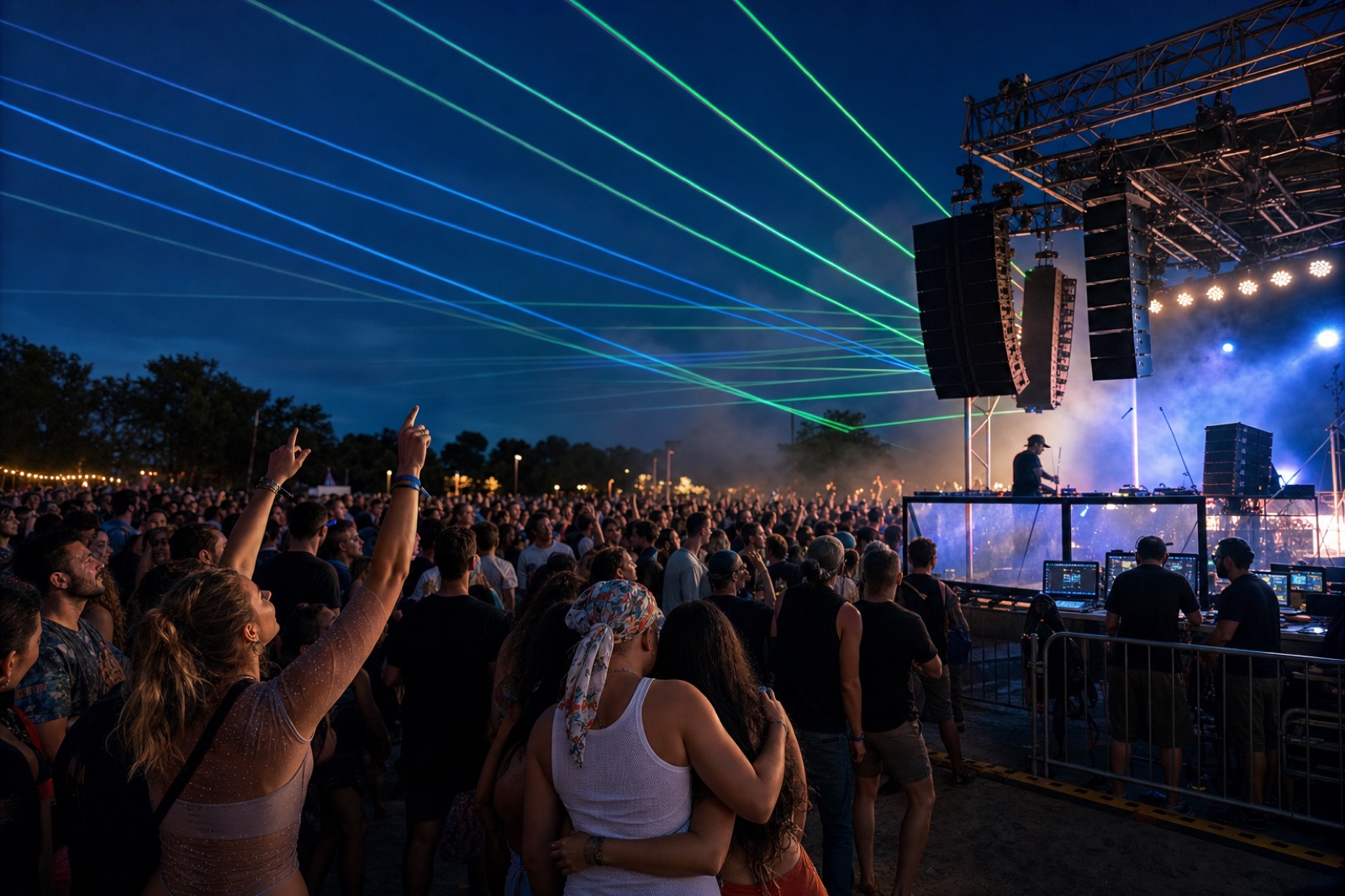
How Festival Laser Shows Work, and Are They Safe?
Festival laser shows mix red, green and blue lasers and steer the beam with fast scanning mirrors, while haze makes the light visible in the air. In the US, show lasers above a low power class need an FDA variance, beams normally stay well above the crowd, and outdoor beams into the sky go through FAA review. Properly run shows are designed to keep hazardous light off the audience.
How does a festival laser show work?
A laser projector combines red, green and blue lasers into one beam, then bounces it off two small, fast-moving scanner mirrors to draw beams, fans and shapes. Haze in the air catches the light so the crowd can see it, and an operator runs the show from software or a lighting console.
Pangolin, a maker of laser show software and projectors, explains the basics in its education pages. The colors are merged with dichroic filters, and the scanners are two high-speed motors on the X and Y axes, each carrying a mirror and driven by a servo amplifier that follows signals from the control system. A technique called blanking switches the laser off between parts of an image so separate elements don't connect with faint lines.
Shows tend to use three kinds of effect. Beam effects are the sheets, tunnels and fans that sweep over a crowd. Graphics are logos, text and animations projected onto a surface. Mapping traces the lines of a stage or building with light.
Why lasers need haze to show up
Clear air hides a laser beam. Pangolin's guide states plainly that even the most expensive laser is invisible in clear air, which is why stages run haze machines: the fine particles scatter a little of the light toward your eyes, and the beam appears as a solid line.
That is also why laser looks change from set to set. On a still night with steady haze, beams read as crisp sheets of color. Wind can thin the haze at open-air sites, so the same cue can look faint on one night and dense on the next.
Control is split between the projector and the operator. Professional projectors take signals through an ILDA connection from a laser controller, and many can also be driven over DMX or Art-Net from the same lighting console that runs the stage lights, so lasers can be cued in time with the music. Pangolin lists a manual shutter, a keyswitch and emergency-stop ports among the safety hardware on a professional unit.
Who regulates laser shows in the US?
The Food and Drug Administration does, through its Center for Devices and Radiological Health. FDA rules treat show projectors as demonstration laser products and cap them at Class IIIa, which is 5 milliwatts of visible output. Anything stronger, the Class IIIb and IV lasers big festival shows use, requires an FDA-approved variance.
A variance is formal permission to go beyond that limit under set conditions. According to the FDA's laser light show page, a company must file a product report for the projector, a laser light show report and a variance application, and may begin producing shows only after it receives a variance approval letter. The International Laser Display Association (ILDA), the industry's trade body, adds that an annual report is required to keep the variance active and that the paperwork, procedures and a show checklist must be on site.
States and cities layer on their own rules. ILDA's summary notes that New York licenses laser operators, Illinois requires third-party inspectors on site, and Arizona, Florida, Massachusetts and Texas have notification or registration requirements. Some cities, including Orlando and Portland, require registration with and inspection by the local fire department.
Can lasers legally hit the crowd?
Only under a special FDA approval. ILDA's safety overview says that in the US, beams normally must stay 3 meters (about 9 feet 10 inches) above the surface where the audience stands, and 2.5 meters to the side of or below audience areas. Pointing beams into the crowd, called audience scanning, requires a separate FDA variance.
ILDA is blunt about the alternative: without an audience scanning variance, any audience exposure is likely to be very hazardous and is definitely illegal. The FDA describes the same principle from its side. Shows produced under its rules keep hazardous lasers away from the audience, and where a beam could fall on the crowd, the power is kept below levels known to be hazardous.
People matter as much as hardware. Under the standard variance conditions ILDA summarizes, every show must be under the direct control of a trained operator who can see all beam paths, with help from a spotter if needed, and who has an emergency stop within reach at all times. If a beam drifts where it shouldn't, the operator is expected to stop that laser immediately, even mid-show.
Lasers in the sky: FAA review for outdoor shows
Open-air festivals add a second regulator. The Federal Aviation Administration's Form 7140-1, Notice of Proposed Outdoor Laser Operation(s), must be filed by anyone planning a visible beam brighter than 50 nanowatts per square centimeter in navigable airspace. The form asks for the show's FDA variance number, and ILDA notes that the FDA variance itself requires this FAA review for any outdoor show whose beams may enter airspace.
Each projector setup gets a worksheet with its location, beam power, wavelengths and the angles it will point. Producers also calculate how far each beam stays hazardous and how far it could still dazzle a pilot at three brightness thresholds, down to 50 nanowatts per square centimeter, the level the form ties to laser-free zones. The FAA then replies with a letter that either does not object or explains its objections, and the show must drop or change any effect the FAA objects to.
ILDA recommends filing at least 90 days ahead and using spotters to stop beams near any aircraft. The FDA's own laser show page lists distraction or temporary loss of vision for pilots and drivers among the risks of badly handled lasers.
Are festival lasers safe for your eyes?
Shows run under an FDA variance are built to keep hazardous beams off the crowd, either by holding them above head height or by keeping any light that reaches the audience below hazardous levels. The bigger everyday risk at festivals comes from handheld laser pointers, which is why many events ban them outright.
The power difference is the point. The American Academy of Ophthalmology explains that a laser under 5 milliwatts aimed at someone's eye gives them time to blink or turn away, but the blink reflex can't protect against stronger lasers, and serious retinal damage can follow even a brief exposure. It also relays the FDA's warning that blue and violet lasers can be riskier because the eye is less sensitive to those colors, so people may not blink as fast.
Common sense covers the rest. Don't stare up into a beam source, keep to the crowd areas the festival sets out, and leave any laser pointer at home. If a beam ever seems to strike your eye directly and your vision changes, get it checked by an eye doctor rather than waiting it out.
Laser pointer rules at major US festivals
Festivals with big production budgets keep handheld lasers out. The table lists what the official item policies say for three festivals in our directory: EDC Las Vegas, Ultra Music Festival in Miami and Movement Music Festival in Detroit. Item lists change from year to year, so check each festival's current page before you pack.
For more on what to bring and what to leave home, see our first EDM festival guide. Big-stage production, lasers included, is a staple of the events on our mainstage festivals page, and every date we track is on the festival calendar.
| Festival | Where | Laser pointer rule on the official page |
|---|---|---|
| EDC Las Vegas | Las Vegas Motor Speedway, Nevada | Prohibited, listed with air horns; also banned in Camp EDC |
| Ultra Music Festival | Bayfront Park, Miami, Florida | Prohibited: laser pens, laser pointers and similar focused light devices |
| Movement Music Festival | Hart Plaza, Detroit, Michigan | Prohibited |
Frequently asked questions
Are laser shows at festivals legal in the US?
Yes, when they are produced under an FDA variance. Show lasers above Class IIIa (5 milliwatts of visible output) require an approved variance before use, and outdoor shows that send beams into the sky also go through FAA review. Some states and cities add licensing, inspection or registration rules.
Can a festival laser damage your eyes?
Powerful lasers can injure eyes, which is why US rules keep show beams above the crowd or below hazardous levels where they could reach people. The American Academy of Ophthalmology notes that the blink reflex does not protect against lasers over 5 milliwatts, so beams aimed into the crowd require special FDA approval.
Why do festivals use haze for lasers?
A laser beam is invisible in clear air. Haze machines fill the air with fine particles that scatter some of the light toward the audience, which makes the beam visible as a solid line. Wind at outdoor sites can thin it and change how the lasers look.
Can I bring a laser pointer to a music festival?
Usually not. The official item policies for EDC Las Vegas, Ultra Music Festival and Movement Music Festival all list laser pointers as prohibited. Handheld pointers can be far more powerful than their labels claim, and shining one at people or aircraft is dangerous.
Sources
- U.S. Food and Drug Administration: Laser Light ShowsShow projectors limited to Class IIIa (5 mW visible) under 21 CFR 1040.11(c); Class IIIb/IV require a variance, product report, show report and variance application; shows only after a variance approval letter; power kept below hazardous levels where beams could fall on the crowd; risks to eyes, skin, fire, pilots and drivers.
- International Laser Display Association: Laser Light Show Safety OverviewBeams normally 3 m above audience surface and 2.5 m to the side or below; audience scanning needs an FDA variance; trained operator, beam visibility and emergency stops; FAA review for outdoor beams submitted at least 90 days ahead; annual reports; documents on site; state and city rules.
- Federal Aviation Administration: Form 7140-1, Notice of Proposed Outdoor Laser Operation(s)Filing required for visible beams over 50 nW/cm² in navigable airspace; asks for the FDA variance number; per-configuration worksheet with beam data, directions and protection zones.
- American Academy of Ophthalmology: Is Your Laser Pointer Dangerous Enough to Cause Eye Injury? (2018)Blink reflex protects against lasers under 5 mW but not stronger ones; retinal damage can follow brief exposure; FDA advice never to aim a laser pointer at anyone; blue and violet lasers are riskier.
- Pangolin Laser Systems: What Is a Laser Light Show Projector?RGB lasers combined with dichroic filters; X/Y scanner mirrors driven by servo amplifiers; blanking; beams invisible in clear air without haze; ILDA, DMX and Art-Net control; shutters, keyswitches and e-stop ports.
- EDC Las Vegas: Hours & InfoLaser pointers and air horns are prohibited items.
- Ultra Music Festival: Prohibited & Acceptable ItemsNo laser pens, laser pointers or similar focused light devices.
- Movement Music Festival: What's AllowedLaser pointers listed as prohibited.
Written and checked by the EDMber editors. Festival dates come from official festival sites and are re-checked monthly. How we research and correct articles.