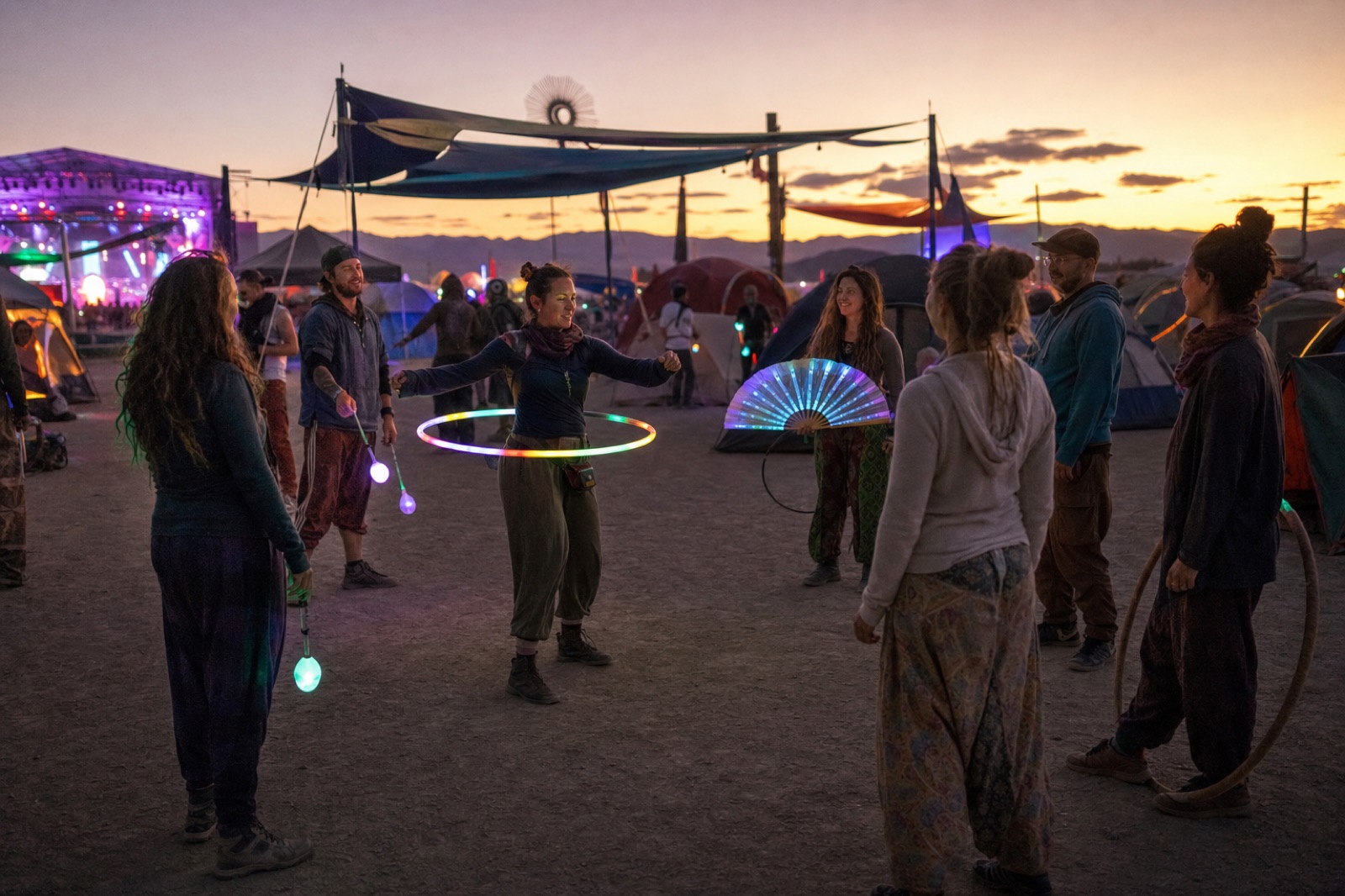
What Are Flow Arts? Hoops, Poi and Festivals
Flow arts are dance-like movement practices built around spinning or manipulating a prop, such as a hoop, poi, staff, fans or a levitation wand, often lit with LEDs or set on fire. Poi comes from Māori tradition in Aotearoa New Zealand. Hooping spread through jam band crowds in the 1990s, and fire dancing grew at Burning Man, which is how flow became part of festival culture.
What are flow arts?
Flow arts are a family of movement practices in which a person spins, swings or balances a prop in time with music, blending dance, juggling and a little martial-arts discipline. Common props are hoops, poi, staffs, fans and levitation wands. At festivals they are usually lit with LEDs, and trained performers sometimes set them on fire.
The word describes the look of it: continuous, looping movement in which the prop never quite stops. You don't need a stage for it. Much of the flow at festivals happens on the edge of a dance floor, at a campsite or in a dedicated flow area where people trade tricks.
Lighting is a big part of the appeal at night. An LED hoop or pair of glow poi leaves trails of color in a camera's long exposure and in the eyes of anyone watching, and spinners have become a familiar sight at night on dance music festival grounds.
Poi: a Māori art before it was a festival prop
Poi, a weight on the end of a cord swung in circles, comes from Māori culture in Aotearoa New Zealand. An essay from the Aotearoa New Zealand Festival of the Arts notes that Taranaki narratives credit Turi, captain of the Aotea waka (canoe), with bringing the poi to New Zealand and using it in chant and ritual.
Its uses have changed over generations. The same essay says young men once used poi mainly as exercise, framed as a game with tricks, timed challenges and added weight, because swinging it works the wrists and forearms. Poi that accompany chant take two forms: poimanu carry a message and poipoi record genealogy. Today the practice is dominated by women and is a familiar part of Māori performance, with modern music shaping many poi songs.
Festival poi builds on that tradition. EDC Las Vegas lists LED poi among its acceptable items, and fire departments count poi among the most common fire performance tools. Knowing where the prop came from is part of using it respectfully.
Hoops, staffs, fans and wands: the main props
Every prop has its own feel, and many flow artists learn several. Fire departments that regulate fire performance list most of the same tools: Portland Fire & Rescue's fire performance policy names wands, poi, hoops, palm torches, staffs, swords, fans, juggling torches and meteors as common fire implements.
- Hoop: a large ring spun around the waist, chest, arms and neck or moved off-body. Festival hoops are often homemade from tubing and many have LEDs inside.
- Poi: two weights on cords swung in circles and weaves around the body, with LED or fire heads at night.
- Staff: a rigid pole spun from the center, handed around the body or balanced; double staffs and longer contact staffs are variations.
- Fans: rigid fans held in each hand and spun or flipped, often with several fire wicks along the edge.
- Levitation wand: a stick on a thin string that, moved with the right hand motions, appears to float in the air.
- Orbitals and other LED toys: smaller handheld spinners that EDC Las Vegas, for one, lists as acceptable.
How did flow arts become part of festival culture?
Two strands met in the 1990s. Jam band crowds, especially fans of the String Cheese Incident, turned hula hoops into a dance-floor habit, while fire performers grew into a formal tradition at Burning Man. Today both show up across dance music events, from LED hoops at big festivals to fire circles at regional burns.
NPR traced the hoop side in a 2005 All Things Considered report. Band lore holds that in the early 1990s, when nobody danced at their small Colorado club shows, friends of the String Cheese Incident started bringing oversized hoops to get people moving. In the mid-1990s band members made dozens of hoops before the Telluride Bluegrass Festival and had them thrown into the crowd during their set. The hoop became the band's emblem, and fans began making their own from heavy irrigation tubing.
That link still shows on the calendar. Suwannee Hulaween in Live Oak, Florida, is hosted by the String Cheese Incident, which plays three nights of the festival. More jam-rooted events are on our jam festivals page.
Fire took a parallel path. Burning Man's Fire Conclave history says Crimson Rose started the tradition in 1991 when she danced with fire at the foot of the Man. A handful of performers grew into hundreds, participation standards were refined in 2005, and today groups of fire dancers perform in the Great Circle around the Man before it burns at Burning Man.
Where to find flow and workshop spaces at festivals
Transformational festivals are the easiest place to start, because they build participation, workshops and performance into the program. Our transformational festivals page lists the ones we track, including Burning Man and its regional events.
Some festivals spell out learning spaces on their own pages. Lightning in a Bottle, produced by the Do LaB in California, runs workshops and talks at The Compass alongside its music stages. Element 11, Utah's sanctioned Burning Man regional event, lists performances, workshops and service projects among the art participants bring, and it points fire performers to its own Fire Performance and Burnable Art Policy.
At larger dance festivals without a formal flow area, spinners usually gather at the edges of stages, in campgrounds and in open lawns. Give spinners room to move, keep drinks and bags out of their circle, and ask before stepping in to try a prop.
What festival rules say about hoops, poi and fire
Prop rules vary widely, so check the official item list before you pack. The table summarizes what official pages say for festivals in our directory. Fire is the strictest category: most large dance festivals ban open flames entirely, and even burn-culture events can switch fire off when conditions turn dangerous.
Apogaea, Colorado's regional Burning Man event, is the clearest recent example. In 2026 fire art was banned after the Stonewall Fire Department found the land too dry, and the event went ahead with a non-flame focus. Burning Man itself allows fire performance, but its rules require each performer to have a dedicated safety person, a fire extinguisher on hand, sobriety and careful fuel handling.
| Festival | Hoops and LED props | Fire |
|---|---|---|
| EDC Las Vegas | Hula hoops, including LED hoops, and LED poi and orbitals are acceptable; red light-up wands are banned | No fires or flames of any kind in Camp EDC |
| Movement Music Festival | Hula hoops allowed, subject to search | Fireworks prohibited |
| Ultra Music Festival | Poles, sticks and totems prohibited | Flammable items and liquids prohibited |
| Burning Man | Part of the culture | Fire performance allowed with a dedicated safety person, extinguisher and fuel rules |
| Apogaea | Part of the culture | Fire art banned in 2026 after the local fire department found the land too dry |
Fire spinning safety: what fire marshals require
Fire spinning is a trained skill, not something to try for the first time at a festival. Fire codes give a good picture of the precautions involved. Portland Fire & Rescue's fire performance art policy, which references NFPA 160, the National Fire Protection Association standard for flame effects before an audience, sets out requirements that are typical of the practice:
- A 20-foot clear distance between any flaming prop and the audience or combustible items, widened by 5 feet when several performers share the space.
- Two safety people per performance, one guarding the perimeter and one acting as a dedicated spotter trained in burn first aid.
- A fire extinguisher rated at least 2A-10BC near each spotter, plus a wet cotton towel, wool or Nomex blanket, or duvetyne to put out props.
- No gasoline under any circumstances, fuel stored in its original or a metal lidded container, and excess fuel spun off into a spin-out bucket before lighting.
- Snug clothing made of fire-resistant materials or natural fibers such as cotton, wool or leather; synthetic clothing is not allowed.
- Permits that can be canceled during a burn ban or when the fire marshal decides the hazard is too high.
Frequently asked questions
What counts as a flow art?
Any practice that uses a spun, swung or balanced prop as a dance partner counts. The most common are hooping, poi, staff, fans and levitation wands. At festivals they are usually performed with LED props, and trained performers sometimes use fire versions with fuel-soaked wicks.
Where does poi come from?
Poi comes from Māori culture in Aotearoa New Zealand. Taranaki narratives credit Turi, captain of the Aotea waka, with bringing it to New Zealand. Young men once used it as exercise for wrists and forearms; today it is mostly performed by women as part of Māori performing arts.
Can you bring a hula hoop to a music festival?
Often, yes. EDC Las Vegas lists hula hoops, including LED hoops, as acceptable items, and Movement in Detroit allows hula hoops subject to search. Rules differ by festival, though: Ultra Music Festival bans poles, sticks and totems, so check each event's official item list.
Is fire spinning allowed at festivals?
Usually only where the festival builds it into the program. Most large dance festivals ban open flames. Burning Man and some regional burns allow fire performance with a dedicated safety person, extinguishers and fuel rules, and events can cancel fire entirely when the land is too dry.
Sources
- Aotearoa New Zealand Festival of the Arts: A Window into Te Ao Māori: the PoiTaranaki narratives credit Turi, captain of the Aotea waka, with bringing poi to New Zealand; poi as exercise for young men; poimanu and poipoi; today dominated by women.
- NPR: Hula Hooping Gets Groovy Again (All Things Considered, 2005)String Cheese Incident fans' hooping craze; friends brought oversized hoops to early-1990s Colorado shows; band made hoops for the Telluride Bluegrass Festival in the mid-1990s; hoops from irrigation tubing; hoop as band emblem.
- Burning Man: Conclave HistoryCrimson Rose founded the Fire Conclave in 1991; growth to hundreds of performers; standards refined in 2005; performances in the Great Circle before the Man burns.
- Burning Man: Fire PerformanceEach fire performer needs a safety person with wet towels or duvetyn; BC-rated extinguisher; performers must be sober; fuel kept in marked containers; no dumping or spinning off fuel on the playa.
- Portland Fire & Rescue: FIR 3.07 Fire Performance Art policyLists common fire implements; 20-foot distance plus 5 feet for multiple performers; two safety personnel; 2A-10BC extinguisher and wet cotton towel or duvetyne; no gasoline; natural-fiber clothing; permits canceled during burn bans; references NFPA 160.
- EDC Las Vegas: Hours & InfoHula hoops including LED hoops and LED poi and orbitals are acceptable; red light-up wands are prohibited.
- EDC Las Vegas: Camp EDC GuidelinesNo open campfires or fires or flames of any kind in Camp EDC.
- Movement Music Festival: What's AllowedHula hoops allowed subject to search; fireworks prohibited.
- Ultra Music Festival: Prohibited & Acceptable ItemsNo poles, sticks or totems; no flammable items or liquids.
- Element 11: FAQPerformances and workshops among participant art; fire performers follow the Fire Performance and Burnable Art Policy.
Written and checked by the EDMber editors. Festival dates come from official festival sites and are re-checked monthly. How we research and correct articles.