What Is an Art Car? Mutant Vehicles Explained
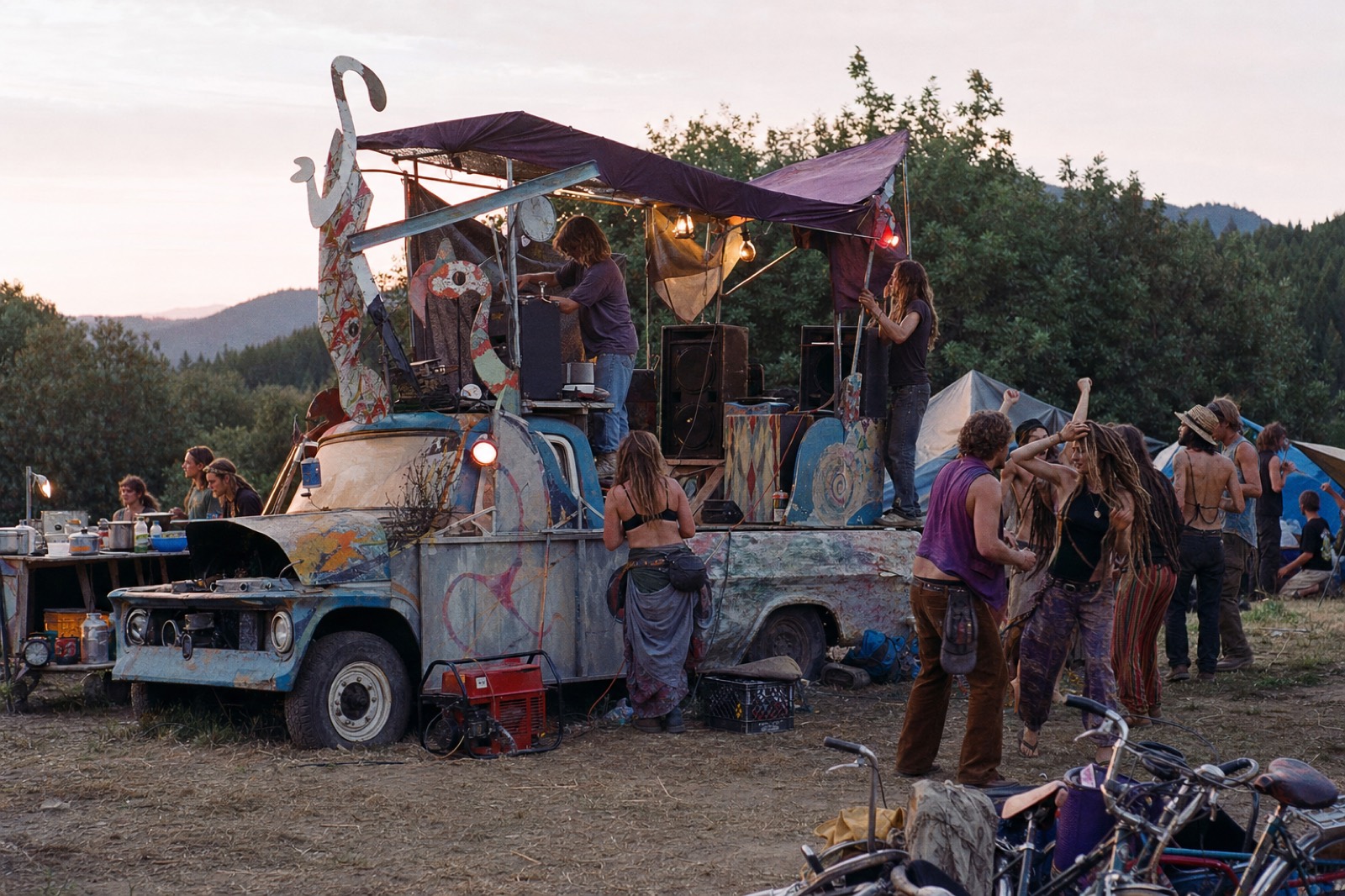
An art car is a vehicle rebuilt as moving artwork. At Burning Man the official term is Mutant Vehicle: a car, truck or scratch-built machine changed so much that it no longer looks like a street vehicle, licensed by the Department of Mutant Vehicles and driven at 5 mph, often with a sound system and riders aboard. Regional burns run similar licensing of their own.
What counts as an art car or Mutant Vehicle?
An art car is any vehicle rebuilt or decorated as a piece of art. A Mutant Vehicle is Burning Man's stricter category: a motorized creation built from scratch or changed so radically that it is no longer recognizable as a street or stock vehicle, and licensed to drive in Black Rock City.
Burning Man's help center gives a sense of the range: motorized furniture, boats and trains that travel over land, or a pirate ship or spaceship crossing the desert. Its licensing criteria ask for four qualities. A vehicle should be radically mutated, offer an interactive experience, operate safely and be well lit.
Plenty of decorated vehicles fail that test. The criteria rule out vehicles that keep their stock shape, cars covered in fabric or fur without changing their outline, art bolted on top of an unmutated base, and machines stripped down to the frame and engine. Low riders, classic and custom cars, monster trucks, dune buggies, rat rods and hot rods are excluded too, as is anything resembling an emergency or police vehicle. A fur-covered golf cart, in other words, is still a golf cart.
Art cars before Burning Man: Houston's parade
Decorated cars had a public stage well before most people heard of the playa. In Houston, the Orange Show Foundation auctioned the Fruitmobile at its 1984 gala: a 1967 Ford station wagon that artist Jackie Harris covered in paint and plastic fruit. According to the parade's official history, the Houston Art Car Parade then debuted in April 1988 under the Orange Show's leadership, with 40 vehicles and an estimated crowd of 2,000.
That street-parade tradition treats the car as a canvas that still drives on public roads. The playa version went further, because its vehicles never need to be street legal. They only need to be safe at walking pace on a dry lakebed, a freedom that helps explain why so many look like ships, animals or buildings rather than cars.
How the Department of Mutant Vehicles licenses a car
Within Burning Man, the Department of Mutant Vehicles (DMV) registers and licenses Mutant Vehicles, along with vehicles for participants with disabilities. Its stated job is to let builders share their creations while keeping Black Rock City foot- and bike-friendly, safe, and within the event's land-use permit. Not every vehicle that applies gets in.
Demand explains why. According to the DMV's criteria page, it receives nearly 1,000 applications a year and aims for 650 or fewer licensed vehicles, in a city of about 80,000 participants. Owners file a statement of intent and then a full application with photos or sketches, and volunteer reviewers decide which vehicles are invited.
Licenses come in day and night versions. A night license requires the vehicle to be fully and radically illuminated, since an unlit machine on a dark playa is a hazard to everyone walking or biking nearby. Separate street and playa-only licenses cover where a vehicle may drive, and no vehicle may drive on the Esplanade, the innermost street facing the open playa.
Safety standards in the licensing criteria are specific:
- A steady speed of 5 mph or less, the speed limit in Black Rock City
- Brakes in good working order and no sharp or protruding objects
- Guard railings 36 to 48 inches above the floor, with boarding gaps no more than 36 inches wide
- Headlights that reach at least 30 feet ahead, plus lighting on every side so the vehicle reads as one continuous shape
- A separate fire-safety license for any flame effects
Sound cars and the rules on amplified music
Many art cars carry sound systems, and some work as mobile dance floors with DJ gear on board. Burning Man's Mutant Vehicle sound policy sets out where that music can play. On the open playa, amplified sound is allowed at any hour without a volume cap in nearly all areas. In the city streets, it is allowed from 10 a.m. to 2 a.m.
From 2 a.m. to 10 a.m., sound must be off, meaning inaudible from outside the vehicle, while driving through the city, until the vehicle is back in camp or at least 100 yards out from the Esplanade. Two large-scale sound zones, called DMZ and DMZ 2, let vehicles play as loud as they want, with speakers pointed away from the city. Music must also stop at the Temple burn perimeter.
Enforcement is strict. A first violation brings immediate revocation of the vehicle's DMV license, and the vehicle has to return to camp and stay parked for the rest of the event. Further infractions can get it ejected from the city.
Big EDM festivals use art cars differently, as production pieces built for the show rather than participant projects. Insomniac's magazine, for example, profiled the One-Eyed Monster Art Car that towered over crowds at EDC Las Vegas in 2014.
Rules for riding an art car
Riding is part of the point. Burning Man's licensing criteria treat interactivity as extra credit and urge owners to offer rides whenever they can, and they expect every vehicle to have a safe access area and a procedure for loading passengers. Someone built and fueled that vehicle, and the ride is a gift, so the crew sets the terms. Regional events spell out more of the rider's side:
- Board and leave only at a full stop. Playa del Fuego's rules allow loading and unloading passengers only when the vehicle is fully stopped.
- Stay inside the railings. Burning Flipside requires passengers to be reasonably protected from falling while the vehicle moves, with a safe place to get on and off.
- Use pickup points where they exist. Flipside asks operators to stop at designated Pick Up Points to offer rides.
- Give ground guides room. Playa del Fuego requires large or low-visibility vehicles to use them, so follow their directions when they wave you back.
- Expect the car to yield to you, not the reverse. Burning Man's survival guide gives pedestrians and bicycles the right of way over motor vehicles.
- Follow the crew's lead. Ask before climbing on, stay off ladders or upper decks they have closed, and step down when they say the ride is over.
Where to see art cars at listed burns and festivals
Licensed art cars roll at Burning Man and at regional burns that run their own vehicle departments, including Burning Flipside, Apogaea and Playa del Fuego. The table pairs each event's official vehicle rules with location and age details from EDMber's festival listings. Dates live on each festival page and the festival calendar.
Approval does not carry over from one year to the next. Playa del Fuego says so directly, and Apogaea notes that registering alone does not guarantee a license, because every vehicle still faces an on-site inspection. Owners at those events reapply each year.
For the camps that build and park these vehicles, see what a theme camp is, or browse every transformational festival EDMber lists.
| Event | Location (EDMber listing) | Ages (EDMber listing) | Vehicle rules on official pages |
|---|---|---|---|
| Burning Man | Black Rock City, Nevada | All ages | DMV license required; 5 mph; day and night licenses; Mutant Vehicle sound policy |
| Burning Flipside | San Gabriel, Texas | All ages | Any vehicle not 100% human powered must be licensed; 5 mph maximum; up to 102 inches wide and 35 feet long; fire extinguisher required |
| Apogaea | Valdez, Colorado | Not listed | Two-step DMV registration, then on-site inspection; 5 mph or less; stairs and ladders must be lit |
| Playa del Fuego | Tamaqua, Pennsylvania | Not listed | Pre-registration and on-site inspection; 5 mph; passengers load and unload only at a full stop |
| EDC Las Vegas | Las Vegas, Nevada | 18+ | Art cars appear as festival production pieces; Insomniac profiled one from the 2014 edition |
Frequently asked questions
Is an art car the same as a Mutant Vehicle?
Not exactly. Art car is the general term for any vehicle turned into artwork, including street-legal parade cars. Mutant Vehicle is Burning Man's licensing category for vehicles changed so heavily that they no longer look like a street or stock vehicle, approved by its Department of Mutant Vehicles.
How fast can art cars drive at Burning Man?
The speed limit in Black Rock City is 5 mph at all times, and Mutant Vehicles must hold that pace. Burning Flipside, Apogaea and Playa del Fuego use the same 5 mph limit, and Apogaea and Playa del Fuego ask drivers to go slower in tight crowds.
Can anyone ride an art car?
Usually, yes. Burning Man's criteria encourage owners to offer rides whenever they can, but the crew decides who boards and when. Wait for a full stop, climb on only where the crew directs, stay inside the railings and step off when asked.
Do I need a separate license for a regional burn?
Yes. Regional burns run their own vehicle departments. Burning Flipside licenses any vehicle that is not fully human powered, while Apogaea and Playa del Fuego require pre-registration and an on-site inspection, and approval does not carry over from one year to the next.
Sources
- Burning Man: Mutant Vehicle Criteria and LicensingEligibility criteria, excluded vehicle types, 5 mph, railing and lighting rules, day and night licenses, application and license numbers
- Burning Man: Department of Mutant VehiclesDMV's role, accessibility vehicles, and keeping the city foot- and bike-friendly
- Burning Man Help Center: What is a Mutant Vehicle?Definition and examples such as furniture, boats and trains; no emergency look-alikes
- Burning Man: Mutant Vehicle Sound PolicySound hours in the city, quiet hours, DMZ zones, Temple burn rule and penalties
- Burning Man Survival Guide: Vehicles & Driving5 mph limit, no driving on the Esplanade, pedestrian and bike right of way
- Houston Art Car Parade: HistoryFruitmobile in 1984 and the parade's April 1988 debut with 40 vehicles
- Burning Flipside: Mutant VehiclesLicensing for non-human-powered vehicles, 5 mph, size limits, rider protection, pickup points, right of way
- Apogaea: Art Car & Mutant Vehicle Info & PoliciesTwo-step registration, on-site inspection, 5 mph, lighting of stairs and ladders
- Playa del Fuego: Mutant VehiclesPre-registration, 5 mph, loading only at a full stop, ground guides, no carry-over approval
- Insomniac: The Art of EDC Las Vegas: Electric Daisy and the One-Eyed Monster Art CarArt car production piece at EDC Las Vegas 2014
Written and checked by the EDMber editors. Festival dates come from official festival sites and are re-checked monthly. How we research and correct articles.