What Is a Theme Camp at a Festival?
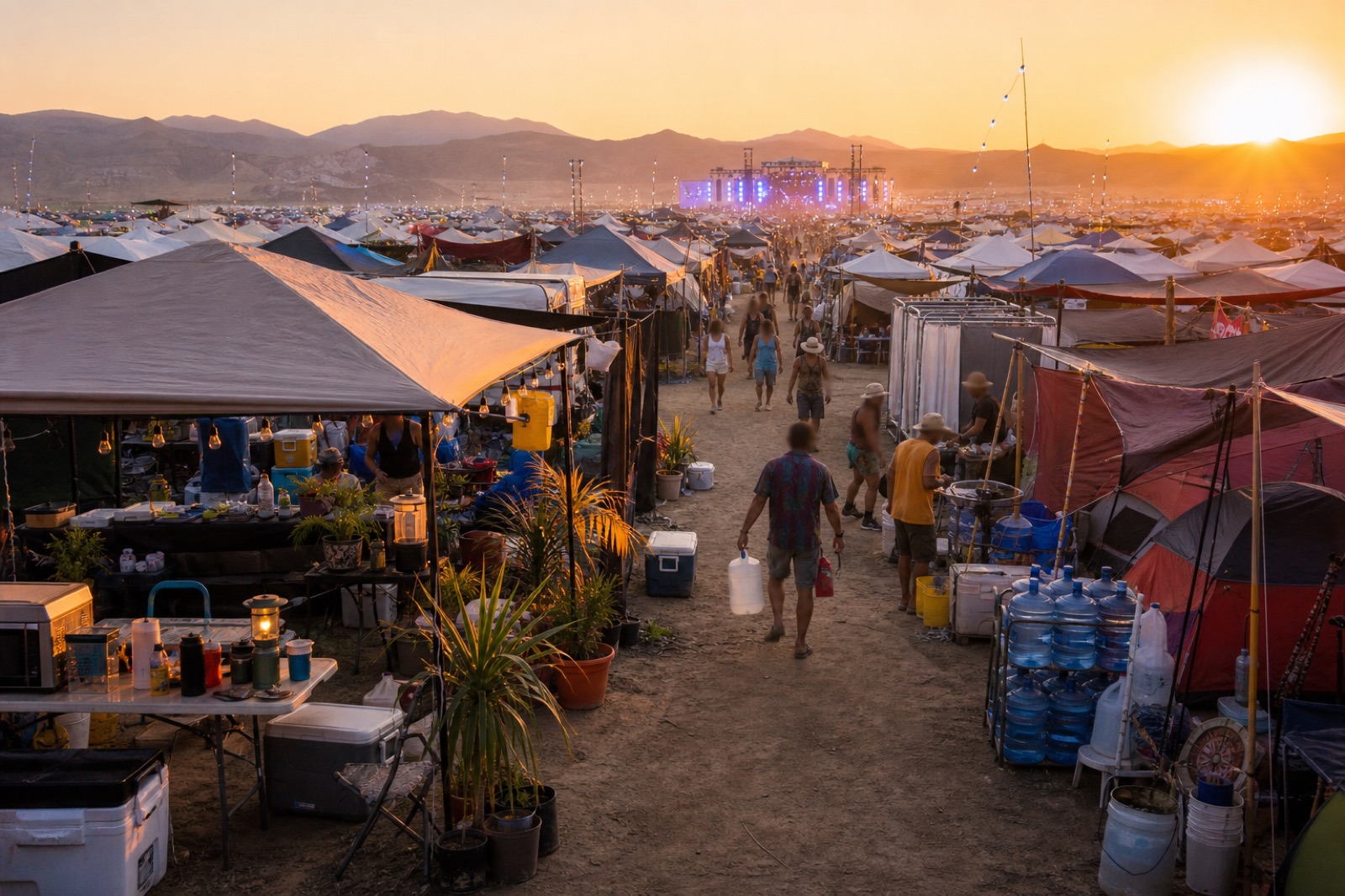
A theme camp is a group of campers who pool their effort to offer something to everyone else, such as a lounge, a workshop, a dance floor, art or shade. Burning Man judges theme camps on interactivity and places them on a mapped street grid, which is how a campground becomes a temporary city. Regional burns use the same model, and some festivals build camp neighborhoods of their own.
What is a theme camp?
A theme camp is a group of participants who camp together and share something with the wider event, whether a service, an activity, art or another interactive experience. Burning Man uses that definition when it reserves space for camps, and it judges them on interactivity, visual impact and how original their offering is.
The idea separates a theme camp from a group of friends parked side by side. Friends camp for themselves. A theme camp builds a public space, then opens it to strangers: a shade lounge with a schedule of talks, a dance floor, a breakfast spot or a workshop tent. Burning Flipside, Texas's regional burn, puts it simply on its theme camp page, calling camps its artistic contribution in camp form and encouraging lights and decoration.
Interactivity is the core. Burning Man's placement criteria say interactivity can be almost anything, as long as it happens within the camp, and that larger camps should match their offering to their footprint. There is no formula for that ratio, but a camp that takes up a big block and offers little is unlikely to keep its spot.
How Black Rock City is laid out
Burning Man builds a full street grid on the Black Rock Desert each year, and theme camps give that grid its character. Addresses pair a clock position with a lettered street, so Center Camp Plaza sits at 6:15 and B. According to the city plan, plazas at 3:00, 4:30, 6:00, 7:30 and 9:00 act as mini civic centers ringed by theme and service camps.
Not every block is reserved. Open camping fills blocks between H and K streets, and blue survey flags mark the spots set aside for placed camps, which open campers must stay out of. Past K Street, between 2:00 and 5:00, a walk-in area bans vehicles, so campers park along K and carry gear in. The open playa beyond the city is kept for interactive art.
Sound shapes the map, too. Large-scale sound camps go in zones along the 2:00 and 10:00 streets at the edges of the city, with speakers turned toward the open playa. Everywhere else, the sound policy sets a limit of 75 decibels at the border of a neighboring camp or the middle of the street, whichever is closer.
How Burning Man decides which camps get placed
Placement is competitive. More than a thousand theme camps request placement every year, according to Burning Man's criteria page. Beyond the three theme camp criteria, every placed camp is assessed on being a good neighbor, culture and values, safety procedures, cleanup and self-reliance, and each year camps are rated as in good standing, limited standing or not in good standing.
The process runs on a published cycle. A Statement of Intent opens in mid-December for new and returning theme camps, and a single camp lead completes a Placed Camp Questionnaire in the spring. The Placement team draws the city map and announces selections in May, shares approximate addresses and dimensions in June, and introduces neighbors in July.
Camps that are not placed can still come. Burning Man notes that camps can find space in open camping and set up independently, and it hopes every camp follows the placement criteria whether or not it gets a reserved spot.
Theme camps at regional burns
Burning Man says there are over 80 official Regional Events each year, all created by local communities, and most borrow the theme camp model on a smaller scale. Lakes of Fire, which calls itself the Great Lakes Region's official Burning Man Regional Event, says its home hosts both theme camps and open camping. Burning Flipside runs an annual registration window for theme camps and registers art and vehicles separately.
The table lists the regional and burn-style events in EDMber's directory, with locations and age policies from our festival listings. Every one is a camping event. Love Burn is included because it grew from the same culture, though its site says it has had no affiliation with Burning Man Project since 2024. Browse more on the transformational festival hub.
| Event | Location | Ages (EDMber listing) | From EDMber's listing |
|---|---|---|---|
| Apogaea | Valdez, Colorado | Not listed | Colorado's regional Burning Man event, established 2005 |
| Burning Flipside | San Gabriel, Texas | All ages | Began in 1998 as Burning Man Texas |
| Critical Northwest | Granite Falls, Washington | All ages | Seattle's official regional, run by Ignition Northwest volunteers |
| Element | Snowville, Utah | All ages | Utah's only sanctioned Burning Man event; about 1,800 participants |
| Lakes of Fire | Luther, Michigan | Not listed | Great Lakes Region's official regional event |
| Love Burn | Virginia Key Beach, Miami, Florida | Not listed | Beachfront camping event; no Burning Man Project affiliation since 2024 |
| Playa del Fuego | Tamaqua, Pennsylvania | Not listed | Mid-Atlantic's oldest regional, a volunteer-run gift economy |
Camp neighborhoods at Electric Forest
Commercial camping festivals do not run placement, but some organize their campgrounds into neighborhoods. At Electric Forest in Michigan, campers split between the general admission campgrounds and Good Life, the festival's VIP program, which offers camping close to Sherwood Forest.
The festival seeds its campgrounds with shared spaces. Neighborhood Pods, marked by large inflatable animals, offer information, medical help, showers and ice sales, and they double as drop-off points for the camp gear donation program. Workshops, classes and panels run at The Brainery on Main St. in the GA campgrounds, and Ground Control staff in purple shirts roam both the GA and Good Life campgrounds to help.
Groups of friends at events like this often build their own shared shade, kitchens and lounges. That is camp culture without formal placement, and the same good-neighbor habits apply. Our festival camping etiquette post covers them.
How do you join a theme camp?
You find a camp whose offering you want to help build, then contact it before ticket and planning season. Burning Man's help center stresses that joining a theme camp is not required, and it points to archived camp listings, its ePlaya and Spark platforms, social media and local regional groups as ways to find one.
Regional communities are the easiest door, which is why the help center sends people to local groups. Going to a nearby burn such as Apogaea in Colorado or Element in Utah lets you meet camps in person before committing to a bigger trip.
Ask each camp what it expects before you commit: how shared costs are split, which build and teardown shifts you would cover, and how much time you would spend staffing the public offering.
Starting your own camp
A new camp needs a clear offering, a lead and a plan for self-reliance. At Burning Man, new theme camps are encouraged to file a Statement of Intent, and every camp seeking placement needs a single lead to complete the questionnaire and act as the main contact. Placed camps are expected to be good neighbors, operate safely and be self-reliant.
Size the offering to the space you ask for. The placement criteria ask camps to match interactivity to their square footage, and large camps should especially aim to bring something substantial. Plan sound with neighbors in mind: Burning Man asks camps to keep amplified sound within the limits and check in with neighbors about volume.
Regional burns run their own processes. Burning Flipside opens theme camp registration in a set window early in the year, so watch each event's announcements.
Leave No Trace in a temporary city
Burning Man calls Black Rock City the largest Leave No Trace event in the world, and cleanup is part of a camp's standing. Its criteria say camps aim for green on the MOOP Map (MOOP means matter out of place), and must take responsibility when they miss. Camps are also expected to leave the playa promptly after the event.
Cleanup reaches beyond each camp's block. The survival guide asks every participant to spend two hours on general cleanup outside their own camp and encourages neighboring camps to team up for MOOP sweeps of streets, public spaces and the open playa.
The same habits apply at any festival campground, and they match the National Park Service's Leave No Trace principles: pack it in and pack it out, inspect your site for trash and spilled food, and be considerate of other visitors. Find camping events by state, such as Colorado or Texas.
Frequently asked questions
Do you have to join a theme camp to go to Burning Man?
No. Burning Man's help center says joining a theme camp is not required. Many participants camp independently in open camping areas, which fill blocks between H and K streets in the city plan, as long as they stay out of spaces flagged for placed camps.
What does a theme camp offer?
Anything interactive that the wider event can enjoy: a lounge, workshops, music, art, food or a service. Burning Man judges theme camps on interactivity, visual impact and uniqueness of offering, and expects larger camps to offer more in proportion to their space.
Do regional burns have theme camps?
Yes. Lakes of Fire says its home hosts theme camps and open camping, and Burning Flipside runs a yearly theme camp registration window. Burning Man counts over 80 official Regional Events each year, and most follow the same camp-based model on a smaller scale.
What is MOOP?
MOOP stands for matter out of place: any trash or debris left on the ground. Burning Man tracks it on a MOOP Map, and camps aim for green. Participants are also asked to give two hours to cleanup outside their own camp.
Sources
- Burning Man: Criteria for Camp Placement & Good StandingTheme camp definition, three criteria, more than a thousand applicants, good standing, MOOP Map, open camping
- Burning Man: Placement Process & TimelineStatement of Intent, questionnaire, May map, June addresses, July neighbors
- Burning Man Survival Guide: 2026 City PlanPlazas, Center Camp address, open camping between H and K, walk-in camping, open playa for art
- Burning Man: Sound Policy in Black Rock City75-decibel limit and large-scale sound zones along 2:00 and 10:00
- Burning Man Help Center: How do I join a camp?Joining a camp is not required; ways to find camps
- Burning Man: Global Events & GroupsOver 80 official Regional Events each year
- Burning Man Survival Guide: Respect Your Neighborhood and Clean Up Matter Out of PlaceTwo hours of cleanup per participant and neighborhood MOOP sweeps
- Burning Flipside: Theme CampsTheme camps as artistic contribution in camp form; registration window
- Lakes of Fire: Official siteGreat Lakes Region's official regional event hosting theme camps and open camping
- Electric Forest: Pass TypesGood Life is the VIP program with camping close to Sherwood Forest
- Electric Forest: Experiences & ActivitiesThe Brainery in the GA campgrounds and camp gear donation at neighborhood pods
- Electric Forest: Festival Info & PoliciesNeighborhood Pods and Ground Control in the GA and Good Life campgrounds
- National Park Service: Leave No Trace Seven PrinciplesPack it in, pack it out and consideration for other visitors
Written and checked by the EDMber editors. Festival dates come from official festival sites and are re-checked monthly. How we research and correct articles.