Festival History
Sky River Before Woodstock: The Washington Field Test Festival History Forgot
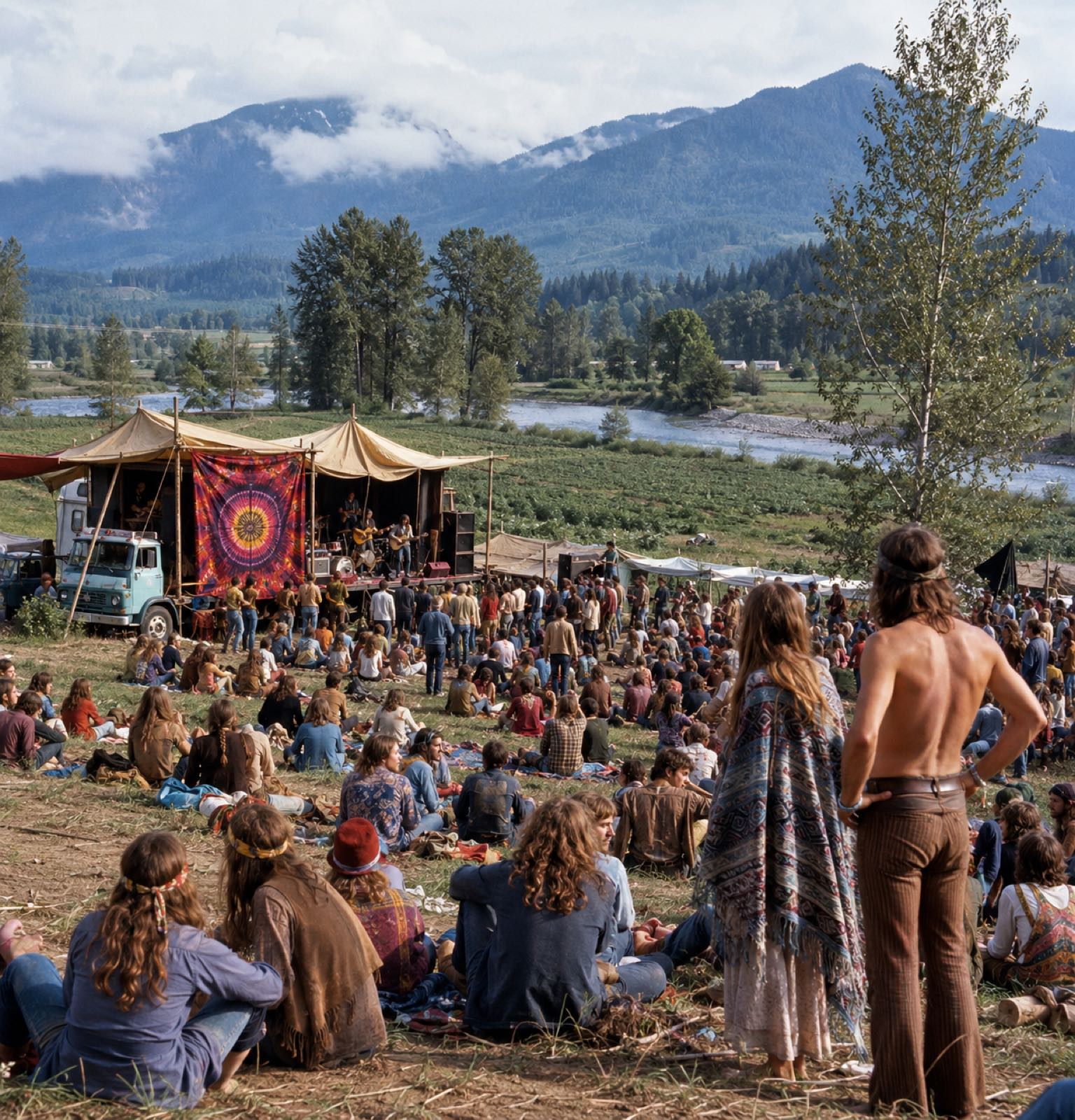
Sky River Rock Festival and Lighter Than Air Fair opened near Sultan on August 30, 1968, and turned a Northwest pasture into one of America's earliest multi-day outdoor rock festival tests.
Direct answer
Sky River Rock Festival and Lighter Than Air Fair opened on August 30, 1968, in a pasture near Sultan in Snohomish County, before Woodstock became the national shorthand for rural rock festivals. HistoryLink describes Betty Nelson's organic raspberry farm, 20,000 attendees, $6 advance tickets, $8 gate tickets, 40 confirmed acts, rain, mud, water shortages, and an unscheduled Grateful Dead appearance. Its importance is practical: Sky River showed how counterculture spectacle becomes festival infrastructure.
Watch this topic
Save the related directory search
Track new events, profiles, and calls matching Sky River Rock Festival history. The saved watch resolves against the live directory when you open it.
Article-to-directory guide
Keep moving from the article
Use these focused routes to move from the article into live events, talent, and application calls without starting from scratch.
Before Woodstock, Sultan Got The Test Run
Start in Snohomish County, not Bethel, New York. On August 30, 1968, Sky River Rock Festival and Lighter Than Air Fair opened a three-day run near Sultan, and HistoryLink calls it one of America's first multi-day outdoor rock concerts. That timing matters. Woodstock would arrive in 1969 with the larger mythology, but Sky River was already testing the rural-festival recipe in Washington: a pasture, a handmade stage, a crowd that did not fit normal venue assumptions, and organizers trying to learn logistics while the weekend was already happening. The useful point is not regional bragging. It is that festival culture rarely appears fully formed. It stumbles into being through roads, borrowed land, local nerves, weather, ticket math, sound, and the awkward discovery that a field becomes a city the minute enough people believe the same rumor. Sky River matters because that discovery happened before the country had a clean script for what such a weekend should cost, permit, promise, or repair.
The Piano Drop Lit The Fuse
Sky River did not come from nowhere. HistoryLink ties its birth to the Piano Drop held four months earlier in Duvall on April 28, 1968, backed by KRAB and the Helix newspaper. More than 3,000 people came to watch Larry Van Over's falling-piano idea and hear Country Joe and the Fish. The event made money, which gave Paul Dorpat a dangerous promoter's question: if thousands would travel for one band and a doomed piano, how many might come for a dozen bands, or more? That is the hinge. A joke became proof of demand. The Piano Drop showed that the Northwest counterculture could gather a crowd in a rural place for art, sound, absurdity, and communal inconvenience. Sky River took that lesson and made it longer, wetter, riskier, and much harder to clean up. The leap from stunt to three-day festival is where charm becomes an operating plan and every bad assumption finds a microphone.
Betty Nelson Gave The Dream A Field
The place came from Betty Nelson, whose organic raspberry farm near Sultan sat along the Skykomish River, roughly 30 miles northeast of Seattle. HistoryLink describes a large pasture cradled in a natural amphitheater, which is exactly the kind of phrase that sounds idyllic until you remember somebody still has to handle roads, toilets, generators, trash, and tired humans. Nelson's land gave the idea a body. Without a site, counterculture remains conversation. With a field, it becomes a permit problem, a neighbor problem, a weather problem, and eventually a memory. That is why the farm detail matters for modern EDM campout culture. Every destination festival still begins with the same bargain: the beauty of a remote site in exchange for the operational burden of making that site survivable. The romance and the risk arrive in the same truck. Betty Nelson's pasture was generous, but generosity did not remove the need for systems once thousands of people turned the land into a weekend address.
The Name Came From A Smoky Table
The name sounds inevitable only after the fact. HistoryLink places Paul Dorpat, Walt Crowley, Scott White, Gary Finholt, John Bixler, John Cunnick, Tim Harvey, and possibly Tom Robbins in the naming orbit, gathered in Wallingford with candles, incense, and enough atmosphere to make a planning meeting feel like a ritual. Someone said Skykomish River, someone shortened it to Sky River, and someone added Rock. Larry Van Over's Lighter Than Air Fair phrase remained attached because he was still dreaming about tethered balloon rides. That naming scene is more than hippie color. It shows how festivals are built from competing dreams before they are built from fences. Some people wanted music to be the center. Van Over wanted air. Others wanted revolution, communion, or simply a weekend that proved ordinary rules could bend. The final title carried all that argument in one overloaded banner. Even now, the name feels like a poster arguing with itself: landscape, music, spectacle, and weather all trying to headline at once.
The Money Was A Dare
The financing reads like a dare with paperwork. Cyrus Noe, the Helix Society Editor and former University of Washington noncredit-extension director, brought UW instructor John Chambless into the mix. John Chambless, Dorothy Chambless, and Cy Noe helped drive the project, and John and Cy co-signed notes for $40,000 in seed capital. HistoryLink adds that plans were made to donate profits to Native American organizations. Tickets went on sale in mid-July before a single band had been signed, at $6 for all three days in advance and $8 at the gate. Pause there, because that is the promoter's cliff edge. They sold a promise before the lineup existed, then had to make the promise real. Modern festival fans know the shape of that anxiety: early-bird trust, poster suspense, and the hope that the people holding the money can build the weekend before the weekend arrives. The difference is that Sky River was doing it without the later machinery of platforms, sponsorship decks, fan apps, and weather alerts.
Forty Acts And One Very Honest Frog
As the date neared, Walt Crowley's poster listed 40 confirmed acts, and the source's frog-poster anecdote is almost too good because it exposes the whole tension. The poster showed a frog on a rock smoking what Cy Noe preferred local authorities not think too hard about. Noe had been reassuring officials that the festival would gather fine American youth in the great American outdoors. Crowley, less allergic to truth in advertising, reportedly argued the frog could be sold as smoking a cigar. That little argument is festival culture in miniature: public respectability outside, counterculture wink inside, and everybody hoping the sheriff appreciates amphibian ambiguity. The actual performer list had real weight: Santana, Big Mama Thornton, James Cotton, Country Joe and the Fish, Richard Pryor, Dino Valenti, the Youngbloods, Easy Chair, Juggernaut, and more. The lineup was not tidy, but it was alive. It also showed that the Northwest could assemble a bill with national pull and local roots before the national festival market knew what it wanted to become.
Then Twenty Thousand People Arrived
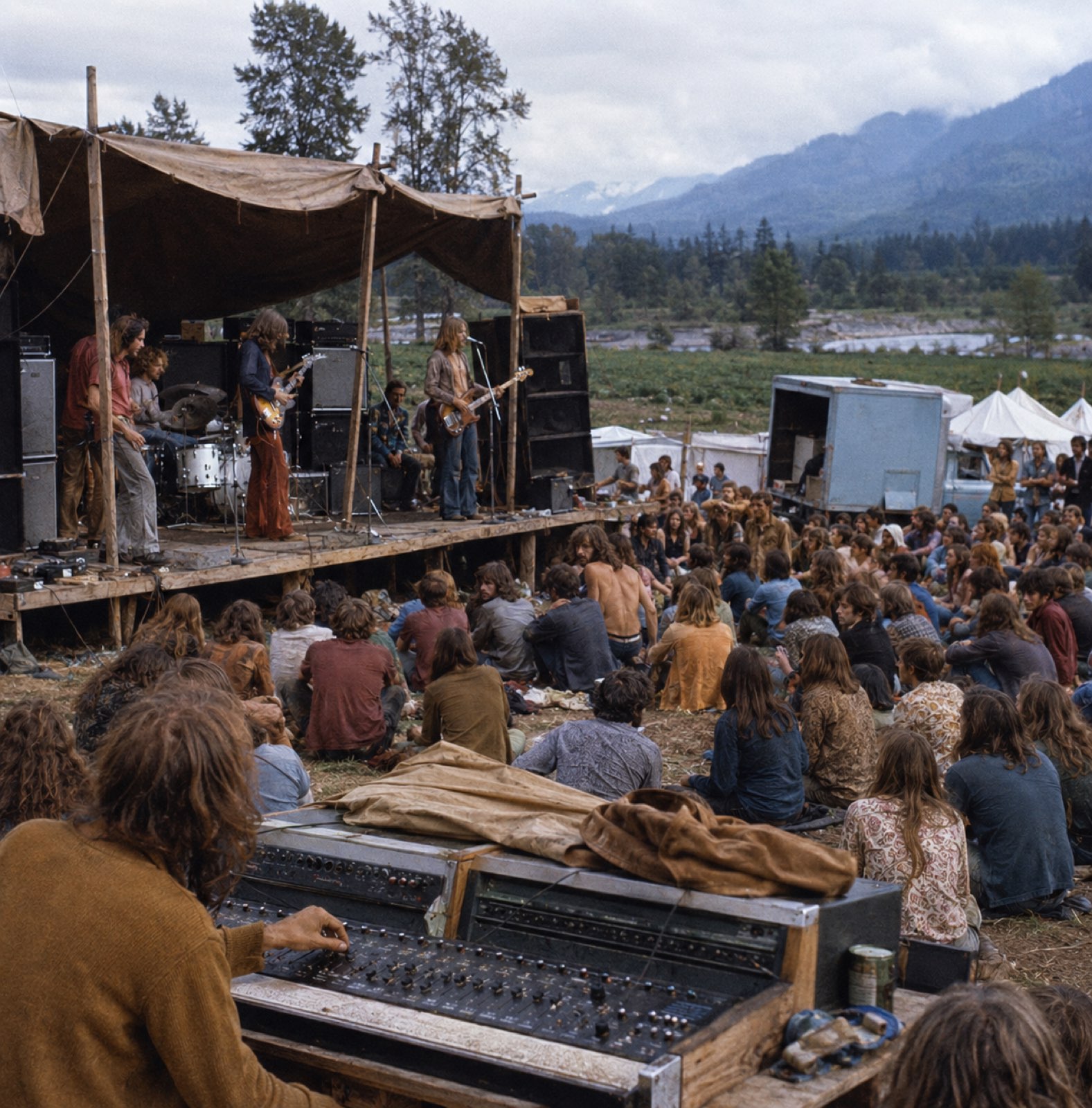
HistoryLink's logistics section is where the myth gets useful. A giant stage went up. Tents were erected. Generators ran. Miles of wire were strung. portable toilets arrived, though not nearly enough of them. Then came 20,000 people, some prepared, many not, and some who even paid. Roger Downey was put in charge of security and quickly made the sanest choice available: strategic retreat. Cyrus Noe's phrase for the problem, "like trying to steer an avalanche," is funny because it is accurate. Festival organizers still recognize the feeling. A crowd is not a line item once it starts moving. It is weather with opinions. The early arrivals grabbed campsites. The masses followed. The field turned into a living system faster than the systems built to manage it. That is the part every modern campout should study without nostalgia fogging the lesson. The lesson is blunt: romance does not scale unless bathrooms, wire, roads, and sober decisions scale with it.
The Music Kept Outrunning The Plan
Bands and performers moved through an improvised machine. Drivers shuttled acts from Sea-Tac to rooms at the Camlin Hotel, home of the Cloud Room, then out to Sultan. Larry Van Over filled his balloon with helium, tied it to a truck bumper, and watched it leave after about 10 minutes, which is a complete festival metaphor wearing no disguise. The crowd had come for music anyway. Some 50 groups had committed, not all appeared, and the Grateful Dead arrived unscheduled. HistoryLink says enough bands showed up to keep the stage moving 18 hours a day for three days. That is the sound lesson: the festival survived because performance kept supplying purpose while logistics wobbled. Modern EDM weekends work the same way. The right set can make a bad walk feel heroic, but the walk is still bad if nobody fixes it next year. Sky River's music was not electronic, but its stage stamina points toward the same all-weekend contract later dance festivals would amplify.
Rain, Mud, Lanterns, And Water
The first night brought rain, and the field turned to mud. The HistoryLink image is strong: from the stage, darkness scattered with fires and lanterns looked like a prehistoric encampment. The next day, sun briefly baked the mud, clothes came off, and hundreds joined a dance around and inside a deep pool of ooze. This is the part where festival history gets funny, then serious again. Joy does not erase infrastructure. The event ran short of drinking water, and Sultan townsfolk trucked it in for free. That detail deserves more attention than any legend of naked mud dancing. The surrounding community did not merely tolerate a counterculture crowd; at a key moment, it helped keep people okay. Modern festivals talk about community all the time. Sky River shows community as a water truck, a local decision, and the choice to treat strange visitors as humans rather than a nuisance.
September 2 And The Long Drive Back
By the afternoon of September 2, It’s a Beautiful Day finished the last set, and the temporary city had to become a field again. The stage was disassembled, tents came down, cables were coiled, litter was collected, and a caravan of battered trucks, VW buses, and vans headed back toward ordinary life. That ending is the hidden festival test. Anyone can mythologize arrival. Cleanup tells the truth about the bargain. Sky River's first edition became hard to repeat precisely because first times carry a charge no infrastructure can manufacture on command. The following year, the second Sky River Rock Festival moved near Tenino, south of Olympia, but HistoryLink notes that outdoor rock concerts had become more common by then and the second event did not capture the first one's success. The blueprint had escaped the original field. That is success and loss in the same sentence.
Why EDM Campouts Still Live In Its Shadow
Sky River was not an EDM festival, and forcing that claim would flatten the music history. Its relevance is structural. Modern EDM campouts inherited the field problem: how to turn remote land into a temporary city with stages, power, water, toilets, medical care, roads, camps, food, lights, security, cleanup, and enough shared belief that discomfort becomes part of the story rather than the whole story. Sky River proved that a crowd would travel for a multi-day outdoor music experience before the national myth had a neat brand name. It also proved that wonder creates obligations. If 20,000 people come, they need water. If it rains, mud becomes policy. If the balloon flies away, the music had better hold. That is the Washington blueprint people forget: a festival is not the poster. A festival is the entire weekend learning how to survive itself. That lesson still belongs beside every modern camp map, every weather alert, and every promise that a field can become a home for a few impossible days.
Quick FAQ
When and where was Sky River Rock Festival?
Sky River Rock Festival and Lighter Than Air Fair opened on August 30, 1968, in a pasture near Sultan in Snohomish County, Washington.
Why is Sky River important before Woodstock?
HistoryLink describes Sky River as one of America's first multi-day outdoor rock concerts, held in 1968 before Woodstock became the best-known rural festival shorthand.
What does Sky River teach modern EDM campouts?
It shows that multi-day field festivals are logistical systems as much as music events: land, roads, water, toilets, weather, cleanup, local communities, and crowd trust decide whether the myth survives.