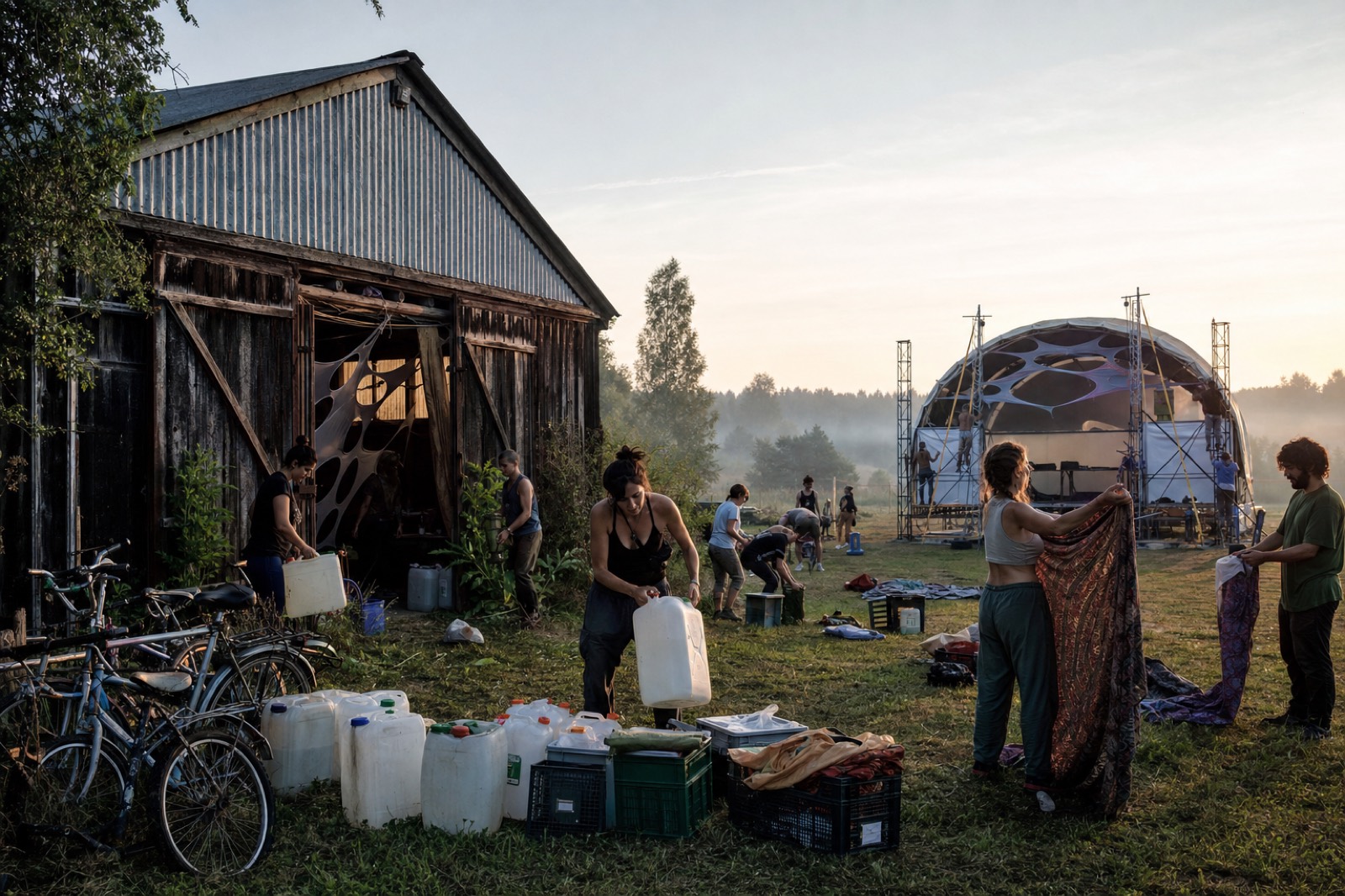
History of Raves: From Warehouses to Festivals
Raves grew out of Chicago house and Detroit techno in the 1980s and exploded as unlicensed warehouse and field parties in Britain in 1988 and 1989, then across the US in the 1990s. Tougher laws, including the UK's Criminal Justice and Public Order Act 1994 and the US RAVE Act of 2003, pushed promoters toward permits, fixed sites and today's licensed festivals.
What was a rave, originally?
A rave was an all-night dance party built around electronic music, usually held outside the licensed club system. Early raves took over warehouses, fields, airstrips and empty factories, with locations often shared at the last minute. The music came from Chicago house and Detroit techno, and the crowds came from everywhere.
That outsider status is the key to the whole story. Because raves happened where clubs could not, they ran into licensing rules, noise complaints and police. Each round of crackdowns pushed organizers toward one of two paths: go further underground, or get permits and become a legitimate event. The festivals on EDMber today are mostly the descendants of that second path.
Chicago's Warehouse and Detroit's techno roots
The sound started in clubs. The Warehouse opened in 1977 at 206 South Jefferson Street in Chicago, with Frankie Knuckles as its first musical director and DJ. Promotional posters billed its nights as house parties, and the style of music Knuckles played there took the name house. He left in 1982 after the admission price doubled, and the city designated the building a Chicago Landmark on June 21, 2023. Our explainer on house music covers the sound itself, and Chicago still hosts ARC Music Festival in Union Park.
Detroit gave the world techno, and the Detroit Historical Society calls the city its birthplace. By the 1990s, Detroit also had a lively rave scene of its own. Red Bull Music Academy's history of that decade describes parties in the Packard Plant, a long-abandoned auto factory, where one night drew more than 1,500 people, alongside crews that threw weekly events in other disused buildings. Police cracked down in 1996 and 1997, and after a 1998 local TV report the city's gang squad adopted a zero-tolerance policy toward raves. Read more in what is techno.
Acid house and Britain's Second Summer of Love
Britain is where raving became a mass movement. Several DJs who would shape early British house nights holidayed in Ibiza in the summer of 1987 and came home wanting to recreate what they heard. London clubs such as Danny Rampling's Shoom and Paul Oakenfold's Spectrum at Heaven followed, and the summers of 1988 and 1989 became known as the Second Summer of Love.
Tabloid coverage arrived fast. Mixmag dates The Sun's first acid house scare story to August 17, 1988, centered on Spectrum. As pressure on London venues grew, the scene moved outward. Promoters including Biology, Energy, Genesis and Sunrise threw huge parties in fields and warehouses around the M25 orbital motorway, which is why they are remembered as orbital raves. In June 1989 the tabloids covered a Sunrise event held at White Waltham airstrip in Berkshire.
The state responded on two fronts. A national police unit known as the Pay Party Unit was formed in summer 1989 to investigate party organizers. In December 1989, Conservative MP Graham Bright proposed a bill that became the Entertainments (Increased Penalties) Act 1990, raising the maximum fine for organizing an unlicensed party from £2,000 to £20,000 and allowing up to six months in prison.
Castlemorton 1992 and the Criminal Justice Act
Bigger fines did not end free parties. Over the late-May bank holiday in 1992, sound systems including DiY, Circus Warp and Spiral Tribe set up on Castlemorton Common near Malvern. VICE puts the crowd at roughly 30,000 people over about a week, calling it the biggest illegal rave in UK history. Thirteen Spiral Tribe members were later arrested and tried, and all were acquitted.
Castlemorton is widely credited with prompting the Criminal Justice and Public Order Act 1994. Section 63 gave police power to break up open-air gatherings where amplified music was played during the night. As first enacted, it applied to gatherings of 100 or more people; in England and Wales the threshold now stands at 20. A police superintendent can direct people to leave if two or more are preparing such an event, or ten or more are waiting for or attending one.
The Act also defined music, in a phrase that became infamous, as sounds wholly or predominantly characterized by the emission of a succession of repetitive beats. Its effect was to push large unlicensed gatherings further to the margins and make licensed venues and permitted events the normal home for dance music in Britain.
How US raves moved from warehouses to permits
Many of today's biggest American festival brands began as underground parties. Insomniac says it got its official start in October 1993 with an event in a warehouse in South Central Los Angeles. It launched Nocturnal Wonderland in 1995, now its longest-running festival brand, and debuted Electric Daisy Carnival at the Shrine Expo Hall in Los Angeles in 1997.
EDC kept growing inside licensed venues. By Insomniac's count, the 2010 edition drew up to 185,000 people over two days at the Los Angeles Memorial Coliseum and Exposition Park. In 2011 the festival moved to Las Vegas Motor Speedway, where EDC Las Vegas still runs with on-site camping and an 18+ age policy.
Detroit's path ran through City Hall. The Detroit Electronic Music Festival launched at Hart Plaza in 2000, organized by Carol Marvin's Pop Culture Media with techno artist Carl Craig, and Red Bull Music Academy describes it as the culmination of a decade of growth in the city's party scene. After several changes of producer, Paxahau took over and renamed it Movement. Movement Detroit is still held downtown at Hart Plaza.
The RAVE Act and promoter liability
Federal law changed the risks for promoters in 2003. Senator Joe Biden introduced the RAVE Act in 2002, but it did not pass on its own. A reworked version, renamed the Illicit Drug Anti-Proliferation Act, was attached to the PROTECT Act, which President George W. Bush signed on April 30, 2003.
Section 608 of that law amended an existing federal statute on premises used for illegal drug activity so that it covered any place used whether permanently or temporarily, and it applied to anyone who manages or controls a place as an owner, lessee or agent. That wording reached one-night events, not just permanent buildings, and the law added a civil penalty of up to $250,000 or twice the gross receipts tied to each violation, whichever is greater.
Critics including the ACLU argued the law could chill legitimate events and punish businesses for the conduct of their customers. In practice, it gave promoters another reason to work with venues, permits, security and medical staff rather than throw pop-up parties in unlicensed spaces.
What licensing changed for the crowd
Moving from warehouses to permitted sites changed the experience in concrete ways. Licensed festivals publish age policies, run ticketing and bag checks, staff medical tents and post rules on what you can bring. They also announce a fixed venue in advance instead of handing out a phone number on the night. The table below shows how a few festivals connected to this history operate today, using details from their EDMber pages.
| Festival | City and venue | Age policy | Camping | Link to rave history |
|---|---|---|---|---|
| ARC Music Festival | Chicago, Union Park | 18+ | No | Held in the city where house music got its name |
| Movement Detroit | Detroit, Hart Plaza | All ages (GA) | No | Grew from the Detroit Electronic Music Festival, first held in 2000 |
| Nocturnal Wonderland | San Bernardino, Glen Helen Regional Park | 18+ | Yes | Insomniac's longest-running festival brand, first held in 1995 |
| EDC Las Vegas | Las Vegas Motor Speedway | 18+ | Yes | Started in Los Angeles in 1997; moved to Las Vegas in 2011 |
Where the rave spirit lives at festivals today
The legal fights of the 1990s left a mark on festival culture, but so did the parties themselves. The shared values that grew up at early American raves, often summed up as PLUR, still shape how crowds treat each other.
If you want festivals closest to the original sound, start with the techno and house listings. For the big permitted spectacles that grew out of 1990s raves, browse mainstage festivals, and use the festival calendar to see what is coming up.
Frequently asked questions
When did raves start?
The music came from Chicago house and Detroit techno in the 1980s. Raves as a mass movement took off in Britain in 1988 and 1989, the so-called Second Summer of Love, when acid house parties spread from London clubs to warehouses and fields around the M25. US rave scenes grew through the 1990s.
Why did the UK pass a law against raves?
After huge unlicensed gatherings, most famously Castlemorton Common in May 1992, Parliament passed the Criminal Justice and Public Order Act 1994. Section 63 lets police break up open-air nighttime gatherings with amplified music, and it defined music as sounds characterized by a succession of repetitive beats.
What was the RAVE Act?
The RAVE Act was a 2002 bill by Senator Joe Biden. A revised version, the Illicit Drug Anti-Proliferation Act, became law in April 2003 as part of the PROTECT Act. It extended an existing federal statute to temporary uses of a place, which raised the legal risk for event promoters and venue owners.
Did EDC start as a rave?
Its producer did. Insomniac began with an underground warehouse event in South Central Los Angeles in October 1993. Electric Daisy Carnival debuted at the Shrine Expo Hall in Los Angeles in 1997, grew into the Los Angeles Memorial Coliseum, and moved to Las Vegas Motor Speedway in 2011.
Sources
- Wikipedia: Warehouse (nightclub)The Warehouse's 1977 opening at 206 South Jefferson Street, Frankie Knuckles as musical director, house parties on posters and the origin of the name, his 1982 departure, and Chicago Landmark designation on June 21, 2023.
- Detroit Historical Society: Detroit Electronic Music Festival (Movement)Detroit as birthplace of techno; the festival's 2000 start at Hart Plaza organized by Carol Marvin's Pop Culture Media with Carl Craig; later producers and Paxahau's Movement.
- Red Bull Music Academy: Craving The Rave: Detroit's Electronic Music Scene in the '90sPackard Plant parties drawing more than 1,500 people, 1996-97 crackdowns, the 1998 zero-tolerance policy, and DEMF as the culmination of a decade of growth.
- Wikipedia: Second Summer of LoveThe 1987 Ibiza trip, Shoom, the 1988-89 timeframe, M25 promoters Biology, Energy, Genesis and Sunrise, the Pay Party Unit, Graham Bright's bill, and the £2,000 to £20,000 fine increase with up to six months' imprisonment.
- Mixmag: The Great British Freak-OutThe Sun's first acid house story on August 17, 1988 about Spectrum at Heaven, the move to M25 raves, and the June 1989 Sunrise event at White Waltham airstrip.
- VICE: Castlemorton Common rave historyCastlemorton in late May 1992, roughly 30,000 people, DiY, Circus Warp and Spiral Tribe, the link to the 1994 Act, and the acquittal of 13 Spiral Tribe members.
- legislation.gov.uk: Criminal Justice and Public Order Act 1994, section 63Current 20-person threshold in England and Wales, police direction powers, and the repetitive beats definition of music.
- legislation.gov.uk: Criminal Justice and Public Order Act 1994, section 63 (as enacted)Original 100-person threshold and the nighttime amplified-music condition.
- Insomniac: How It All BeganOctober 1993 warehouse event in South Central Los Angeles, first Nocturnal Wonderland in 1995, EDC's 1997 debut at the Shrine Expo Hall, up to 185,000 people at the Coliseum in 2010, and the 2011 move to Las Vegas Motor Speedway.
- GovInfo: Public Law 108-21 (PROTECT Act)Approval date of April 30, 2003, and Section 608's whether permanently or temporarily and manage or control language.
- Wikipedia: Illicit Drug Anti-Proliferation ActBiden's 2002 RAVE Act, its failure as a standalone bill, attachment to the PROTECT Act, the civil penalty, and ACLU criticism.
Written and checked by the EDMber editors. Festival dates come from official festival sites and are re-checked monthly. How we research and correct articles.