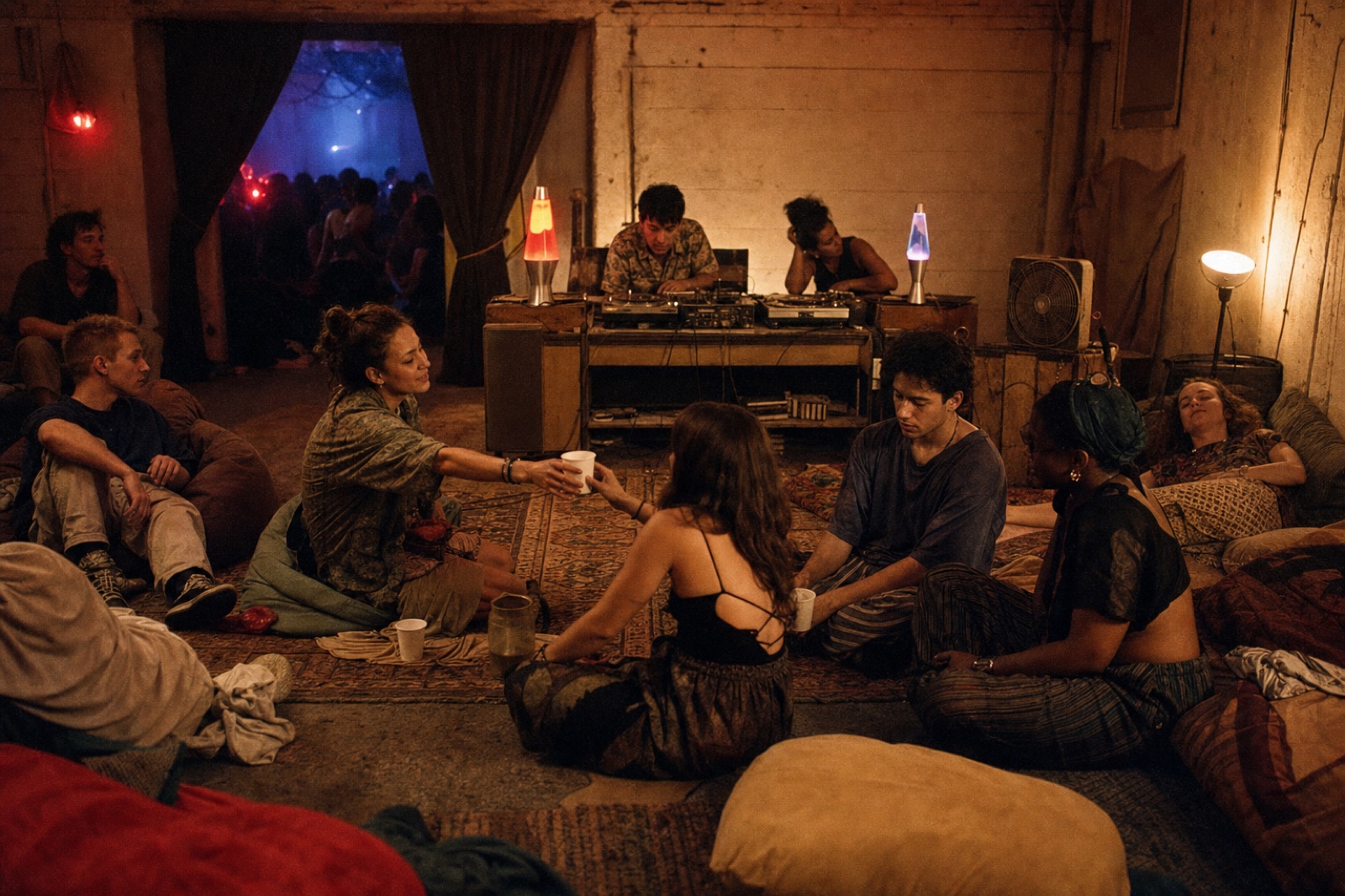
What Is a Chillout Room? Rave History and Today
A chillout room is a quieter space at a club, rave or festival where dancers rest away from the main floor. The idea took hold in London in 1989, when Alex Paterson and Jimmy Cauty played low-volume ambient records in a side room at Heaven. Festivals now offer the same relief through shaded lounges, hammock groves, camps and cool-down areas.
What is a chillout room?
A chillout room is a separate, calmer space at a dance event where people step off the main floor to sit, cool down and let their ears recover. Traditionally it plays slower or beatless music at low volume, often with soft lighting or projections, so the crowd can rest without leaving the party.
Its purpose has always been practical. Dancing for hours in a packed, loud, hot room wears people out, and a quieter space lets them catch their breath, talk to friends and rejoin the floor later. At a club that meant a side room. At a modern festival it is more likely to be a shaded lounge, a grassy corner, a hammock area or your own campsite.
Heaven's White Room and the birth of ambient house
Most histories trace the chillout room to Heaven, a large London club near Trafalgar Square. In 1989 Paul Oakenfold ran an acid house night there called Land of Oz, and according to Sound on Sound around 1,300 people packed the main room on Mondays. Oakenfold brought in Alex Paterson and Jimmy Cauty to run a much smaller space, a VIP area known as the White Room.
Paterson and Cauty did the opposite of the main floor. They played records by Pink Floyd, Brian Eno and 10cc at low volume for about a hundred people, backed by multiscreen video projections. Their kit was modest: three turntables, a cassette deck, a CD player and a mixer. Electronic Sound describes their sets as collages built from soundtracks, field recordings and spoken word, a counterweight to the house records downstairs.
Music writer Simon Reynolds, in his rave history Energy Flash, places the origin of the chill-out idea in that same room and describes its job plainly: giving dancers a chance to chill out from the faster, more emphatic music next door. Paterson has said the roughly six-month residency helped the pair develop ambient house, the slow, spacey offshoot of house music that the room became known for. Paterson went on to lead The Orb, and Cauty went on to work full time with The KLF.
From The KLF's Chill Out to Café del Mar
Ambient house soon had records of its own. The KLF released the album Chill Out on February 5, 1990, on its own KLF Communications label. Electronic Sound calls it half album, half DJ set, a continuous journey across the American South. Sound on Sound reports that Paterson appears on it without credit, though accounts of how much each person contributed vary.
As rave and techno got harder and faster in the early 1990s, chill-out rooms spread. Electronic Sound notes they became especially common in clubs around the time The Orb's second album, UFOrb, reached Number One in the UK in July 1992. The same history traces The Big Chill from a Sunday afternoon session at the Union Chapel in London to a full festival that eventually settled at Eastnor Castle in Herefordshire.
The phrase took on a second life a decade later. DJs at Café del Mar in Ibiza made mixes in the early 2000s that blended ambient house with jazz, classical and new age sources, and the term chill-out music stuck to that sound. So when people say chillout today, they may mean a room, a genre or simply a break.
Why big festivals struggle to keep a room quiet
Large outdoor festivals rarely have a true chillout room, and LA Weekly explained why in a 2015 look at EDC Las Vegas. Its writer found several designated rest areas, including Palace Blue, a domed structure with a grassy lounge, the Buddha Garden and the Caterpillar's Garden, which the festival guide billed as a chill space. None of them played calm music. Sound from nearby stages, including hardstyle from the Wasteland stage, washed over all of them.
The piece points to a few reasons. Modern festival sound systems are louder and heavier on bass than 1990s rigs, which makes isolating a quiet zone on an open site very hard. Tastes also changed: younger fans were more likely to take a break with a different style of dance music than with ambient acts like The Orb. The writer contrasts this with the 1990s, when nearly every rave with more than two areas set one aside for ambient music.
Some festivals have since built spaces that come closer to the old idea. Others lean on shade, water, workshops and open ground. Either way, the quietest spot on a festival site is usually the one farthest from the stages.
Where festivalgoers rest now
Modern rest spaces vary with the site. Official pages and recent coverage describe a handful of approaches at festivals listed on EDMber. Camping status comes from our festival pages; the rest-and-cool-down detail comes from each festival's own information or published reviews.
At Electric Forest, the festival's own page says visitors can relax in a sea of hammocks in Sherwood Forest during the day, and The Brainery hosts meditation and breathwork workshops. Dancing Astronaut's 2026 review of Lightning in a Bottle describes shaded lounge areas across the grounds, a lake for swimming and floating, and daytime yoga and sound-healing sessions. Burning Man tells participants to bring shade for camp and to consider laying low during the hottest part of the day.
| Festival | State or province | Camping | Rest or cool-down option |
|---|---|---|---|
| Electric Forest | Michigan | Yes | Hammocks in Sherwood Forest by day; meditation and breathwork at The Brainery |
| Lightning in a Bottle | California | Yes | Shaded lounges, lake swimming, yoga and sound-healing sessions |
| Burning Man | Nevada | Yes | Bring your own camp shade and rest through the hottest hours |
| EDC Las Vegas | Nevada | Yes | Personal misting fans allowed (1.5L max, empty at entry); free hydration stations |
| Shambhala Music Festival | British Columbia | Yes | Free filtered water stations; ice, freezies and water jugs from the ice vendor |
Heat, sound and pacing: when to step away
A chillout break does real work for your body. The CDC's extreme-heat advice is to seek shade outdoors, take regular rest breaks, spend time in cooler spaces when you can, drink fluids, and wear loose, light-colored clothing and a hat. Those are exactly the things a good festival rest area offers. Our desert festival heat guide covers the warning signs of heat illness in more detail.
Your ears benefit too. The CDC's hearing-loss guidance tells people to walk away from loud noise, take breaks from it and wear earplugs. It also offers a simple test: if you have to raise your voice to be understood, the sound may be loud enough to damage your hearing. Stepping out of the main crowd for a while between sets is one of the easiest ways to follow that advice.
Pacing matters over a multi-day weekend. Many people plan their schedule around the sets they cannot miss and treat the gaps as recovery time, rather than trying to stay on the floor from open to close. If you are new to all this, our first EDM festival guide explains how to plan a day, and post-festival recovery covers getting back to normal afterward.
- Look for shade and water first, then a place to sit.
- Move well back from the speakers, or behind a structure that blocks the sound.
- Check in with friends at a set meeting point during your break.
- Know where the medical tents are before you need them.
Building your own quiet corner at camp
At a camping festival, your campsite can be the chillout room. A shade canopy, a couple of low chairs, a cooler and a small speaker kept at conversation volume give your group a place to regroup between sets. Earplugs and an eye mask make daytime naps far easier when the site never fully goes quiet. Our festival camping checklist has a full packing list.
Transformational events often take this further, with theme camps that host tea, talks or low-key music for anyone who wanders in. Browse transformational festivals to find gatherings where participant-built spaces are part of the culture, or check the festival calendar for camping events near you.
Frequently asked questions
Why is it called a chillout room?
The name comes from its purpose: giving dancers a place to chill out, or cool down and rest, away from faster music on the main floor. Music writer Simon Reynolds traces the idea to the White Room at London's Heaven nightclub in 1989, where Alex Paterson and Jimmy Cauty played ambient records.
What music plays in a chillout room?
Traditionally ambient, downtempo or beatless music at low volume. The first chillout DJs at Heaven played Pink Floyd, Brian Eno and 10cc records at low volume, with video projections. At big festivals today, rest areas often have no music of their own and pick up sound from nearby stages instead.
Do festivals still have chillout rooms?
Some do, though few look like the 1990s version. Many festivals offer shaded lounges, hammock areas, workshops or misting and water stations instead. On open sites with loud stages, the quietest place is often your own campsite or a spot far from the speakers.
Is a chillout area the same as a medical tent?
No. A chillout area is for ordinary rest. Medical tents are staffed by medical practitioners for anyone who feels unwell, and at EDC Las Vegas that care is free. If someone shows signs of heat illness or seems confused, take them to medical staff rather than a lounge.
Sources
- Sound on Sound: The OrbHeaven's Monday Land of Oz night in 1989, roughly 1,300 people in the main room, the White Room VIP area, Pink Floyd, Brian Eno and 10cc at low volume for about a hundred people, the equipment, the six-month residency, and Paterson's uncredited role on Chill Out.
- Electronic Sound: The Big ChillOakenfold inviting Paterson and Cauty to the Land of Oz chill-out room, their sound collages, Chill Out as half album and half DJ set, UFOrb reaching Number One in July 1992, chill-out rooms spreading as rave grew harder, and The Big Chill's path from Union Chapel to Eastnor Castle.
- Wikipedia: Chill-out musicSummary of Simon Reynolds' Energy Flash locating the term in the White Room at Heaven in 1989 and its purpose; the Café del Mar mixes of the early 2000s.
- Wikipedia: Chill Out (KLF album)Release date of February 5, 1990, on KLF Communications.
- LA Weekly: Why Don't Any of EDC Vegas' Chillout Areas Play Chillout Music?2015 description of Palace Blue, the Buddha Garden and the Caterpillar's Garden, sound bleed from nearby stages, louder modern sound systems, changing tastes, and 1990s raves setting aside ambient rooms.
- Electric Forest: Experiences and ActivitiesHammocks in Sherwood Forest by day and meditation and breathwork workshops at The Brainery.
- Dancing Astronaut: Festival Review, Lightning in a Bottle 2026Shaded lounge areas, lake swimming and floating, and yoga, sound healing and workshops as daytime recovery.
- Burning Man: Personal Survival ChecklistAdvice to have shade for camp and to consider laying low during the hottest part of the day.
- EDC Las Vegas: Hours & InfoPersonal misting fans allowed if the bottle is no larger than 1.5L and empty on entry.
- EDC Las Vegas: Health & WellnessFree hydration stations and free on-site care from medical practitioners.
- Shambhala Music Festival: FAQsFree filtered water stations and the ice vendor selling ice, freezies and water jugs.
- CDC: Preventing Heat-Related IllnessSeek shade, take regular rest breaks, use cooler spaces, drink fluids, wear loose light-colored clothing and a hat.
- CDC: Preventing Hearing LossWalk away from loud noise, take breaks from noise, use earplugs, and the raised-voice test.
Written and checked by the EDMber editors. Festival dates come from official festival sites and are re-checked monthly. How we research and correct articles.