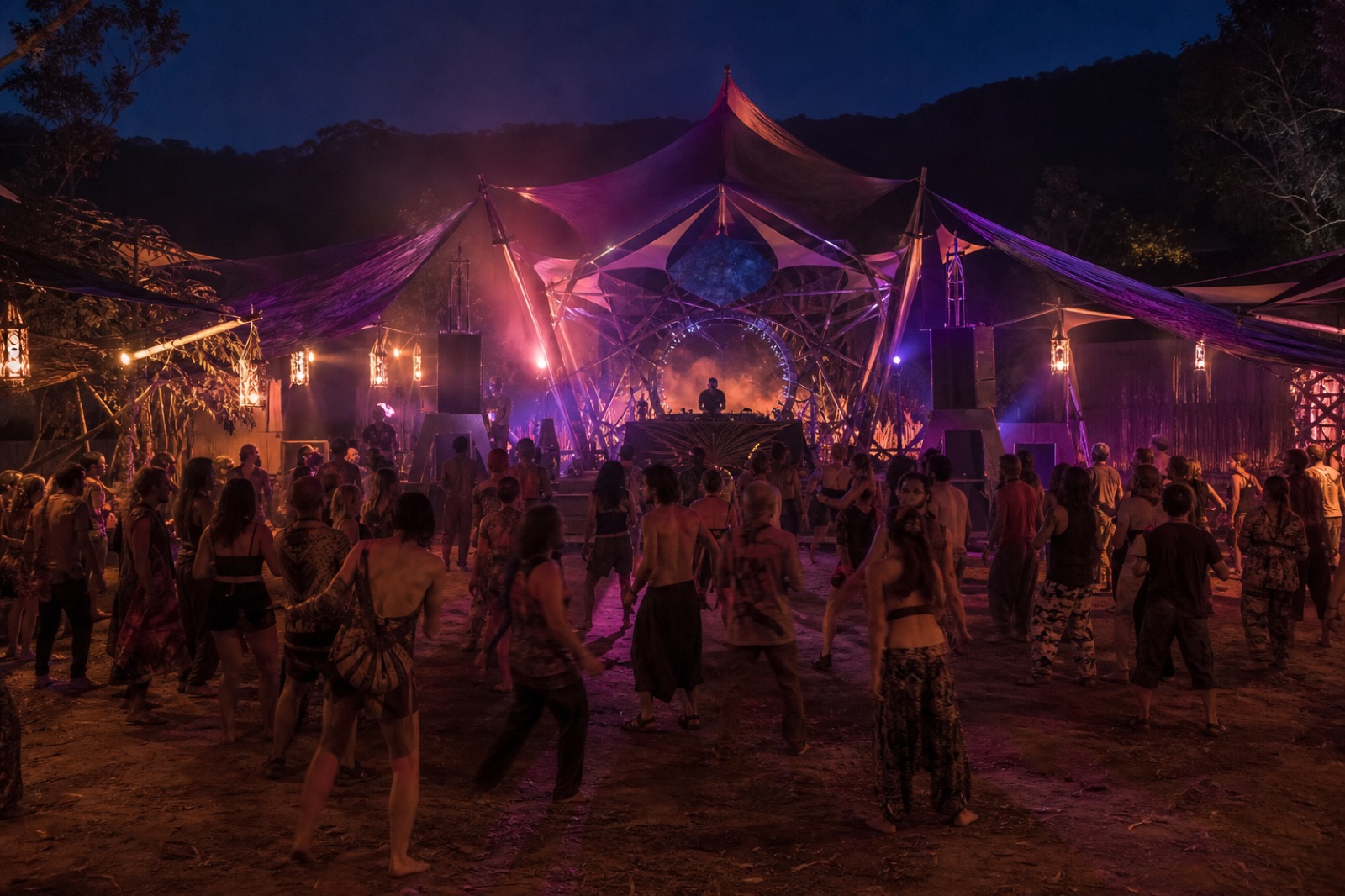
What Is Psytrance? Sound, Roots and Festivals
Psytrance, short for psychedelic trance, is fast, hypnotic electronic dance music built on a rolling bassline under a kick drum on every beat. Most of it runs between about 130 and 150 BPM, and darker styles go faster. It grew out of the Goa trance scene of 1990s India and now has scenes worldwide, including dedicated nights and festival stages in the US and Canada.
What does psytrance sound like?
Psytrance is driving, hypnotic dance music made for long sets. A kick drum lands on every beat, a rolling bassline fills the gaps between kicks, and layered synth riffs twist and evolve over the top. Tracks build, break down and build again. Most styles sit between about 130 and 150 BPM, and the darker styles run faster.
The bassline is the giveaway. Graham St John, an anthropologist who has written and edited several books on the scene, describes progressive psytrance as soaring melodies over a persistent stream of sixteenth notes in the bass. He describes full-on as a relentless rolling bassline that usually fits two or three short bass notes between each kick. If you already know techno or house, listen for that bass pattern first; it is the quickest way to tell psytrance apart.
Sound design carries as much weight as melody. Darkpsy tracks often lift dialogue from horror films, St John notes, while progressive, sometimes called morning trance, leans on soaring melodies. Long sets are part of the culture: Goa Gil's official site describes him playing on for more than 24 hours, and the Guardian reported that at Portugal's Boom Festival the music plays round the clock.
Psytrance styles and their tempos
Psytrance splits into styles mostly by tempo, darkness and the shape of the bass. The ranges below come from St John's 2009 study in the journal Dancecult, a 2009 Dancecult essay on darkpsy by Botond Vitos, and Ektoplazm, a free psytrance netlabel that tags its releases by style. Treat them as typical ranges; plenty of producers move between styles.
The nicknames hint at timing as well as sound: progressive is sometimes called morning trance and darkpsy night trance, according to St John. On a festival schedule, the word psy can cover any of these, so look up the artists if you prefer one end of the range.
| Style | Typical tempo | What to listen for |
|---|---|---|
| Goa trance | No single range; the 1990s template | The melodic, layered sound psytrance grew out of. Ektoplazm files anything with a hint of that golden-age feel under Goa. |
| Progressive psytrance | About 130–145 BPM | Deep, funky, slow-burning grooves and a sixteenth-note bassline under soaring melodies; sometimes called morning trance. |
| Full-on | About 140–150 BPM | High-energy peak-time music with a relentless rolling bassline; St John traces it to Israel and the HOMmega label. |
| Darkpsy | About 150 BPM and up, sometimes past 170 | Heavier, distorted and complex, often with horror-film samples; also called night trance. |
| Forest | Close to darkpsy | Murky, organic and complex; Ektoplazm describes it as an extension of darkpsy. |
| Psybient | Downtempo | Ambient, slower psychedelic music, often with world-music samples, played on chill-out stages. |
Where psytrance came from: Goa in the 1990s
Psytrance grew out of Goa trance, which took shape on the beaches of Goa, India. Mixmag's history of influential parties notes that the former Portuguese colony had been on the hippie trail since the 1960s, and that during the 1980s DJs such as Goa Gil brought Belgian EBM to the parties at Anjuna beach. By the 1990s, Anjuna had developed its own variety of trance.
Goa Gil's life traces the whole arc. St John's 2011 profile of him in Dancecult follows him from San Francisco's Haight-Ashbury psychedelic rock scene in the 1960s to Anjuna in the 1970s, through the switch to a DJ-led electronic scene in the 1980s, the birth of Goa trance in the 1990s, and his later turn to dark psychedelic trance. His official site says he died in October 2023, after nearly forty years of performing his all-night rituals with his partner Ariane.
The sound went global in the mid-1990s. Mixmag credits Paul Oakenfold's Perfecto label with getting behind the scene, and the BBC calls Oakenfold's Goa Mix, first broadcast on Radio 1's Essential Mix on December 18, 1994, probably the most celebrated Essential Mix of all time. St John writes that Goa trance had become a reproducible, sought-after style by the mid-1990s, and that psytrance evolved from it as post-Goa scenes grew across Europe, Israel, North America, Australia, Japan, South Africa and Brazil.
Labels and artists that shaped psytrance
Record labels carried the sound out of Goa. Mixmag names Tip and Dragonfly among the labels started by people from the Anjuna scene, and Tip Records still dates itself to 1994. In Israel, HOMmega, which calls itself psy-trance innovation since 1997, is the label St John links most closely to the full-on style.
A few names to start with:
- Shpongle, which St John calls the chief act in the Goa and psytrance movement. Its debut album, Are You Shpongled?, came out in 1998.
- Infected Mushroom, the Israeli duo of Amit Duvdevani and Erez Eisen, now based in Los Angeles. Their official biography describes them as widely recognized pioneers of psytrance, and they marked 25 years with the release IM25 in 2022.
- Astrix and Tristan, both on the lineup of Insomniac's psytrance-only Into The Sequence night in California. St John's 2009 study includes a photo of Tristan playing Boom Festival's main floor in 2008.
- Ace Ventura, whose official site describes long sets exploring the full spectrum of psychedelic sound and a run of 15 consecutive appearances at Hungary's Ozora Festival.
- Goa Gil, for the ritual, all-night side of the culture and its roots in the original Goa parties.
Learning more about psytrance culture
To hear the styles side by side, Ektoplazm's free catalog is sorted by tags such as progressive, full-on, darkpsy and forest, which makes it easy to compare them track by track. Its descriptions are brief and practical: progressive takes time to build, and darkpsy is the heavier end of the spectrum.
For depth, St John's edited collection The Local Scenes and Global Culture of Psytrance (Routledge, 2010) bills itself as the first scholarly volume of its kind, with chapters on scenes in Goa, the UK, Israel, Japan, the US, Italy, the Czech Republic, Portugal and Australia. His Dancecult study of Boom Festival describes it as the premier event in the international psytrance calendar and a pilgrimage center for the global scene. Boom was first held in 1997 and is staged every two years beside a lake at Idanha-a-Nova in Portugal.
That research also shows why community runs through the culture: participants often describe the experience as tribal, which St John reads as a desire for a shared, sacred kind of togetherness. Many festival-goers will recognize the idea from PLUR.
Where to hear psytrance in the US and Canada
In North America, psytrance turns up in two kinds of places: dedicated nights, and stages inside broader festivals. These are events listed on EDMber where we could confirm psytrance on the bill:
- Into The Sequence: a one-night, 18+ event from Insomniac's Dreamstate brand at the NOS Events Center in San Bernardino, California, held in July. Its ticket page billed a night of pure psytrance, with Astrix, Captain Hook, Infected Mushroom and Tristan on the lineup.
- Dreamstate SoCal: Insomniac's trance festival at the Queen Mary Waterfront in Long Beach, held in November. It is 18+ with no camping, and its 2026 lineup placed psytrance acts such as Astrix, Ace Ventura and Infected Mushroom alongside its trance bill.
Finding psytrance on a festival lineup
Lineups change every year, so start with the psytrance festival list and the wider trance festival list, then check each lineup for the artists above or the labels they release on. At multi-genre camping festivals the psy programming may sit on one stage or on certain nights, so read stage schedules as well as headliners. The transformational festival list is another place to look.
Pace yourself for a long night. Into The Sequence, for example, ran eight hours, from 8 p.m. to 4 a.m. Drink water steadily, take breaks off the floor and wear earplugs for long sets; our first EDM festival guide covers the basics of looking after yourself at an all-night event.
Frequently asked questions
What BPM is psytrance?
Most psytrance sits between about 130 and 150 BPM. Graham St John puts progressive psytrance at roughly 135 to 145 BPM and full-on at 140 to 150, while darkpsy runs from about 150 to 170 BPM or faster. Ektoplazm, a psytrance netlabel, places progressive at 130 to 142 BPM.
Is psytrance the same as trance?
Psytrance is usually filed under trance, and trance festivals such as Dreamstate SoCal book psytrance acts. It has its own lineage, though, rooted in the Goa scene of the 1990s, and its busy rolling bassline and psychedelic sound design make it easy to tell apart once you know what to listen for.
Where did psytrance start?
In Goa, India. Beach parties at Anjuna moved toward electronic music in the 1980s, Goa trance took shape there by the 1990s, and the sound broke out internationally in the mid-1990s, helped by labels such as Tip, Dragonfly and Paul Oakenfold's Perfecto. Psytrance evolved from that Goa sound.
Where can I hear psytrance in the US?
Insomniac's Into The Sequence in San Bernardino was billed as a night of pure psytrance, and its Dreamstate SoCal festival in Long Beach books psytrance acts alongside trance. Browse EDMber's psytrance festival list for current events, and check camping festival stage schedules for dedicated psy nights.
Sources
- Dancecult: Graham St John, "Neotrance and the Psychedelic Festival" (2009)Tempos and traits of progressive (135–145 BPM, sixteenth-note bass, 'morning trance'), full-on (140–150 BPM, traced to Israel and HOMmega) and darkpsy (150–170+ BPM, horror-film dialogue, 'night trance'); psybient stages; psytrance evolving from Goa trance by the mid-1990s and spreading worldwide; Boom Festival's history; Shpongle; participants' 'tribal' framing.
- Dancecult: Botond Vitos, "The Inverted Sublimity of the Dark Psytrance Dance Floor" (2009)Darkpsy's underlying tempo exceeding 150 BPM.
- Dancecult: Graham St John, "DJ Goa Gil: Kalifornian Exile, Dark Yogi and Dreaded Anomaly" (2011)Goa Gil's path from 1960s Haight-Ashbury to Anjuna in the 1970s, the 1980s DJ-led scene, the birth of Goa trance in the 1990s and his later darkpsy.
- Routledge: The Local Scenes and Global Culture of Psytrance (ed. Graham St John, 2010)First scholarly volume on psytrance, with chapters on Goa, the UK, Israel, Japan, the US, Italy, the Czech Republic, Portugal and Australia.
- Mixmag: 25 parties that changed dance music foreverAnjuna Beach entry: Goa on the hippie trail since the '60s, Goa Gil playing Belgian EBM in the '80s, Anjuna's own trance by the '90s, labels Tip and Dragonfly, and Perfecto backing the scene in the mid-'90s.
- BBC Radio 1: Essential Mix, Paul Oakenfold's Goa Mix, 1994First broadcast on December 18, 1994; described as probably the most celebrated Essential Mix of all time.
- The Guardian: Boom time: Portugal's top psytrance festivalBoom as primarily a psytrance festival held every two years at Idanha-a-Nova, with music playing round the clock.
- Ektoplazm: Styles: ProgressiveProgressive psytrance as slow-burning and typically 130 to 142 BPM.
- Ektoplazm: Styles: Full-OnFull-on as high-energy music for peak moments.
- Ektoplazm: Styles: DarkpsyDarkpsy as the heavier end of psytrance, from about 148 BPM and up.
- Ektoplazm: Styles: ForestForest as murky, organic and complex, an extension of darkpsy.
- Ektoplazm: Styles: GoaGoa tag for music with a golden-age feel.
- Tip RecordsLabel's own dating to 1994.
- HOMmegaLabel's description of itself as psy-trance innovation since 1997.
- Goa Gil (official site)His death in October 2023, nearly forty years of rituals with Ariane, and sets lasting more than 24 hours.
- Infected Mushroom: BioIsrael-bred, LA-based duo of Amit Duvdevani and Erez Eisen, recognized as psytrance pioneers; IM25 released in 2022 for their 25th anniversary.
- Ace Ventura (official site)Long sets across a full spectrum of psychedelic sound and 15 consecutive Ozora Festival appearances.
- Insomniac / Front Gate Tickets: Dreamstate Presents: Into The Sequence 202618+ event at NOS Events Center, San Bernardino, billed as a night of pure psytrance from 8 p.m. to 4 a.m., with Astrix, Captain Hook, Coexist, Freedom Fighters, Giorgia Angiuli, Infected Mushroom, Maximizer and Tristan.
- Dreamstate SoCal: Lineup2026 lineup including Astrix, Ace Ventura and Infected Mushroom.
- Dreamstate SoCal: Hours & InfoQueen Mary Waterfront in Long Beach, November event, 18+ entry and no camping.
Written and checked by the EDMber editors. Festival dates come from official festival sites and are re-checked monthly. How we research and correct articles.