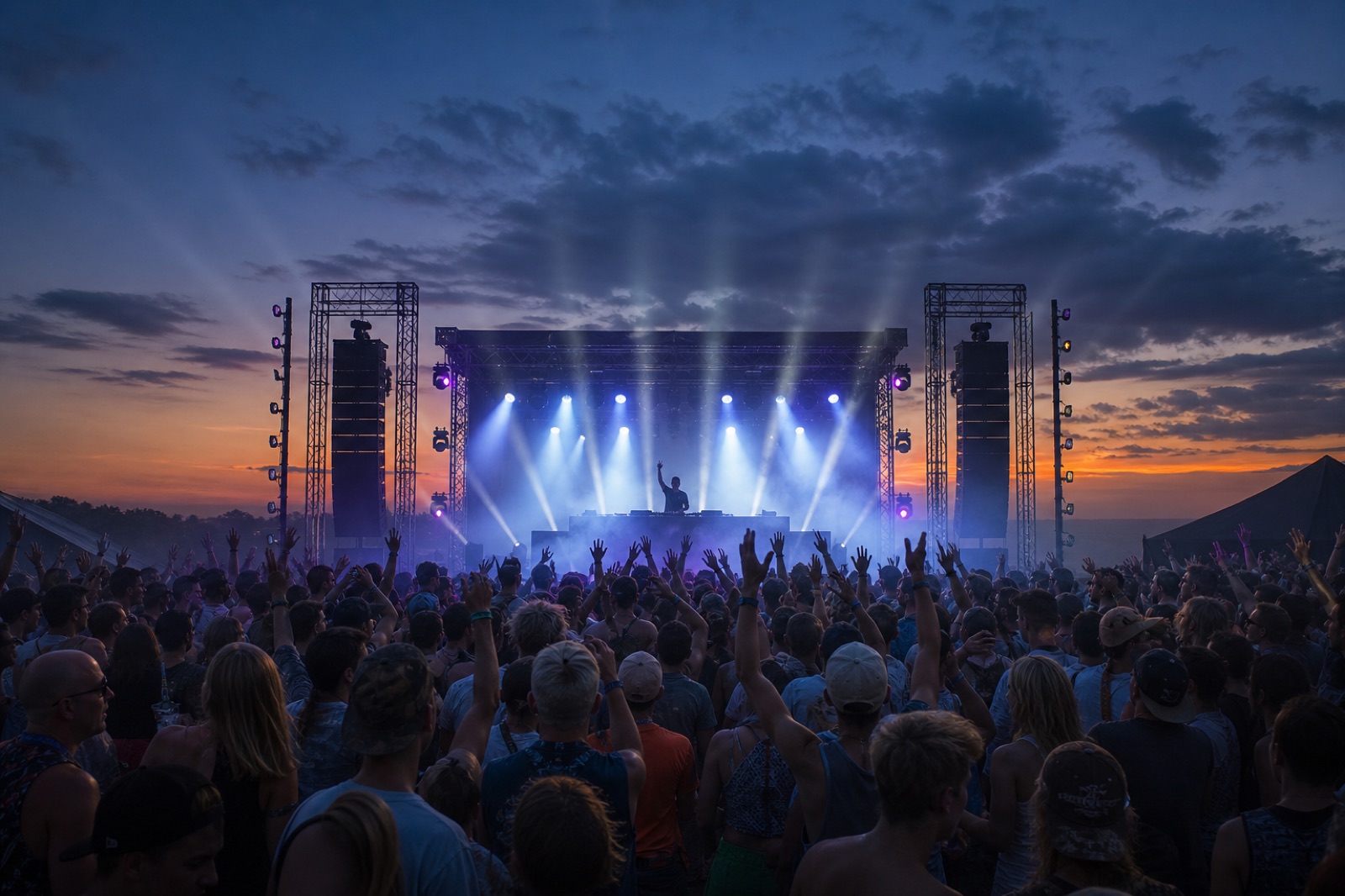
What Is Trance Music? Sound, History and Festivals
Trance is melodic electronic dance music built on a kick drum on every beat, long builds and emotional breakdowns, usually between about 125 and 150 BPM. It took shape in Germany's club scenes in the early 1990s, became an anthem sound in the Netherlands by the end of that decade, and in the US has its own festival brand, Insomniac's Dreamstate.
What does trance music sound like?
Trance is dance music driven by melody and tension. A kick drum lands on every beat while synthesizer chords, arpeggios and pads carry the tune, and tracks move in long waves: a build, a breakdown where the drums fall away, then a return at full power. Berklee College of Music puts the usual tempo at 125 to 150 BPM.
That shape sets trance apart from its neighbors. Berklee's genre guide describes long builds, emotional breakdowns and euphoric drops designed to evoke transcendence, and Insomniac's guide to trance subgenres sums up the progressive style as a breakdown, build and anthem formula. On a festival floor, the breakdown is the moment to watch: the beat stops, a melody plays almost alone, and the crowd waits for the kick to come back.
Two Roland instruments shaped the sound. The TB-303 bass synthesizer, released in 1981, supplied the squelching acid lines on early records such as Hardfloor's "Acperience," according to Arjan Rietveld's listening guide to early trance for Roland. Later came the JP-8000, which Roland lists under 1996 and calls its first synth with the Supersaw waveform. Rietveld describes the supersaw as several slightly detuned sawtooth waves stacked together, a sound that became central to the Dutch anthems of the late 1990s, and he credits Ferry Corsten as one of the first producers to use it. Darude's "Sandstorm" even takes its title from the words Roland's JP-8080 synthesizer displays when it starts up.
Frankfurt, Berlin and trance's German roots
Trance's earliest forms came out of Germany. Rietveld places its earliest forms in the club scenes of Berlin and Frankfurt in the years after the Berlin Wall fell in 1989, and he names Jam & Spoon's "Stella," released in 1992 on the Belgian label R&S, as an early international hit built on synth pads and vocals.
Frankfurt had Sven Väth. Before he became one of techno's best-known DJs, Väth was an early figurehead of the city's trance movement, as Insomniac's history of euphoric trance puts it, and he co-founded the labels Eye Q and Harthouse. Roland's guide points to Cygnus X's "Superstring" as an example of what those labels put out. Ferry Corsten later told Insomniac that the Frankfurt movement was what he considered the first true trance, and the sound he went looking for in record shops.
The labels' founding dates depend on who tells the story. Väth told the German magazine Groove in 2019 that he founded Eye Q and Harthouse in late 1989 or 1990, and that he gave them up in 1997, partly because he no longer wanted to pursue the trance sound. UCM.ONE, which has owned Harthouse since 2017, dates that label to 1992, names Matthias Hoffmann and Heinz Roth as Väth's co-founders, and describes it as Eye Q's harder sublabel until 1997.
Berlin had Paul van Dyk. He grew up in East Berlin before the Wall came down, Mixmag notes, and Insomniac's history of his signature track says an early version of "For an Angel" appeared on his 1994 debut album, 45 RPM. The version most fans know arrived in 1998, reworked under the influence of his residency at E-Werk, a Berlin club in a former electrical substation near Checkpoint Charlie.
How the Dutch scene turned trance into anthems
By the late 1990s the action had moved to the Netherlands. Dutch producers popularized a bigger, more anthemic style, which Rietveld describes in terms of longer major-chord progressions, dramatic breakdowns and the supersaw. Insomniac's history agrees that the euphoric sound, with its harmonies, ethereal breakdowns and driving buildups, owes a large debt to the Dutch.
Much of it started in one Rotterdam record shop. Corsten told Insomniac that a young Tiësto worked at Basic Beat in the late 1990s and knew exactly which melodic records to pull for him. After Corsten played his new track "Out of the Blue" to the regulars there, he and Tiësto made the first Gouryella record together. Roland's guide counts four Gouryella singles and calls the project a hallmark of the Dutch sound that Armin van Buuren, Rank 1 and Three Drives carried forward.
Corsten describes 1999 as the year the whole sound exploded. Alongside "Out of the Blue" and "Gouryella," he names Paul van Dyk's "For an Angel," the Thrillseekers' "Synaesthesia," Armin van Buuren's "Communication" and Rank 1's "Airwave." In the UK, trance grew at clubs such as Cream, Gatecrasher and Ministry of Sound, according to Roland, led by DJs including Paul Oakenfold and released on labels like Hooj Choons, Perfecto and Platipus.
Armin van Buuren and A State of Trance
For many listeners, trance arrives through Armin van Buuren's weekly radio show, A State of Trance. The show's own site dates its first episode to 2001 and says it now airs on about 100 FM stations, with an estimated 40 million listeners in more than 84 countries. Those audience figures come from the brand itself.
The show grew into an events brand. Its site describes an annual event in Utrecht and editions in cities including Sydney, Mumbai, Miami and Mexico City. Van Buuren had just taken first place in DJ Mag's Top 100 DJs poll for the first time when trance enjoyed what Insomniac's history calls a renaissance year in 2008.
In the US, the brand has a long-standing home at Ultra Music Festival in Miami. Ultra says van Buuren has played the festival since 2005, and it billed the A State of Trance stage takeover at its 2026 edition as the 14th in festival history, timed to the show's 25th anniversary.
Progressive, uplifting, tech trance and other styles
Trance splits into styles mainly by tempo and mood. The tempos and names below come from Insomniac's guide to trance subgenres, published in 2015. Treat them as typical ranges, since many producers move between styles and DJs mix them in a single set.
Psytrance is the cousin with its own family tree. It grew out of the Goa trance scene in India, a separate line from the German clubs, and its signature is a rolling bassline that fills the gaps between kicks. Dreamstate books both, and Insomniac describes the brand as covering everything from deep progressive to psytrance. What Is Psytrance? covers its styles and tempos.
Hard trance is another branch worth knowing. Insomniac's guide traces it to Germany, puts it at roughly 140 to 180 BPM, and calls it a precursor to hardstyle.
| Style | Typical tempo | What to listen for | Names Insomniac lists |
|---|---|---|---|
| Progressive trance | About 128–132 BPM | Longer builds and gentler breakdowns; the breakdown, build and anthem formula | Markus Schulz, Sasha, BT |
| Uplifting trance | About 136–142 BPM | Long chord progressions and breakdowns built for a lift; also called epic or anthem trance | Ferry Corsten, Armin van Buuren, Above & Beyond, Dash Berlin |
| Tech trance | Not specified | Techno rhythms, hard synths, heavy delay and distortion, few vocals | Oliver Lieb, Marco V, Simon Patterson |
| Vocal trance | Varies | Overlaps the other styles; built around a sung topline | Paul van Dyk, Tiësto, Delerium, Gareth Emery |
| Acid trance | Not specified | The squelch of the Roland TB-303 | Hardfloor, Art of Trance |
Where can you hear trance in the US?
Start with Dreamstate, Insomniac's trance-only brand, and its Southern California festival at the Queen Mary Waterfront in Long Beach. Beyond that, trance has its own stages inside larger festivals: Quantum Valley at EDC Las Vegas, A State of Trance at Ultra in Miami, and a dedicated trance brand on Groove Cruise.
Insomniac launched Dreamstate in 2015 and billed it at the time as the only dedicated trance brand in the United States. Its first event, at the NOS Events Center in San Bernardino, sold out in four hours, LA Weekly reported. Dreamstate SoCal is 18+ with no camping, and its 2026 lineup pairs an Anjunabeats classics set by Above & Beyond, Ferry Corsten and Paul van Dyk with psytrance acts such as Astrix, Vini Vici and Infected Mushroom. The brand also runs Into The Sequence, a psytrance-only night in San Bernardino.
Multi-genre festivals fill in the map. At EDC Las Vegas, Dreamstate presents Quantum Valley, which EDC describes as covering the entire trance spectrum, from flowing melodies to psychedelic strains. At EDC Orlando, Insomniac Records and Dreamstate host stereoBLOOM, a stage that moves from house and bass music to trance. Groove Cruise Miami runs Embark, which it calls its dedicated trance brand, and Elements in Pennsylvania put Above & Beyond on its 2026 lineup.
Lineups change every year, so check each festival's page and our trance festivals list, and use the festival calendar for dates. Most of these events are in California and Florida.
| Festival | Where | Ages and camping | Trance on the bill |
|---|---|---|---|
| Dreamstate SoCal | Queen Mary Waterfront, Long Beach, California | 18+, no camping | Insomniac's trance festival, from deep progressive to psytrance |
| EDC Las Vegas | Las Vegas Motor Speedway, Nevada | 18+, camping | Quantum Valley, presented by Dreamstate |
| EDC Orlando | Tinker Field, Orlando, Florida | No camping | stereoBLOOM, hosted by Insomniac Records and Dreamstate |
| Ultra Music Festival | Bayfront Park, Miami, Florida | 18+ general admission, no camping | A State of Trance stage takeover (billed as the 14th in 2026) |
| Groove Cruise Miami | Sails from Miami, Florida | 21+ | Embark, its dedicated trance brand |
| Elements Music & Arts Festival | Pocono Raceway, Long Pond, Pennsylvania | 18+, camping | Above & Beyond on the 2026 phase one lineup |
Trance, techno and EDM: telling them apart
Trance and techno share a tempo range. Ableton's Learning Music course lists them together at 120 to 140 BPM, and both put a kick drum on every beat. What sits on top differs: techno leans on repetition and texture, while trance builds toward a melody and a breakdown. For the machine side of the family, read What Is Techno?.
EDM is a broader label, and in the US it usually means the big-stage festival sound. Some trance veterans hear a direct line between the two: Paul Oakenfold has said he always saw EDM as slowed-down trance, as Insomniac's history recounts. Fans call their own community the trance family, a phrase EDC uses for Quantum Valley. Insomniac traces that feeling to clubs such as Gatecrasher, whose regulars pushed early rave's PLUR style to its limits; What Is PLUR? explains the values behind it.
Frequently asked questions
What BPM is trance music?
Most trance runs between about 125 and 150 BPM, the range Berklee gives for the genre. Styles differ inside that range: Insomniac's subgenre guide puts progressive trance at roughly 128 to 132 BPM and uplifting trance at 136 to 142 BPM. Hard trance runs faster, at roughly 140 to 180 BPM.
Who invented trance music?
No single person did. Trance grew out of Germany's club scenes in Frankfurt and Berlin in the early 1990s, where Sven Väth's Eye Q and Harthouse labels were early homes for the sound. Dutch producers such as Ferry Corsten, Tiësto and Armin van Buuren then turned it into a global anthem style by 1999.
Is psytrance the same as trance?
They are related but distinct. Psytrance grew from the Goa trance scene in India and is known for a rolling bassline between kicks, while the trance that came out of German and Dutch clubs leans on chords, melodies and long breakdowns. Dreamstate books both, and EDC's Quantum Valley stage covers the full spectrum.
What is A State of Trance?
A State of Trance is Armin van Buuren's weekly trance radio show, first aired in 2001, which its site says reaches about 100 FM stations. It has grown into an events brand with an annual show in Utrecht, and Ultra Music Festival in Miami billed its 2026 A State of Trance stage takeover as the 14th.
Is there a trance-only festival in the US?
Yes. Dreamstate SoCal, from Insomniac's Dreamstate brand, is devoted to trance in all its forms, from progressive to psytrance. It is held at the Queen Mary Waterfront in Long Beach, California, is 18+ and has no camping. Insomniac also runs Into The Sequence, a psytrance-only night in San Bernardino.
Sources
- Berklee: Electronic Music Genres: A Guide to the Most Influential Styles (Bryan Parys and Aaron Trumm, 2025)Trance at 125–150 BPM in 4/4, emerging in Germany in the early '90s, with long builds, emotional breakdowns and euphoric drops.
- Ableton Learning Music: Tempo and genreTechno and trance grouped together at 120–140 BPM.
- Roland Articles: Listening Guide: Essential Early Trance (Arjan Rietveld, 2022)Earliest trance in Berlin and Frankfurt club scenes after 1989; Jam & Spoon's 'Stella' (1992, R&S); Väth co-founding Eye Q and Harthouse; Cygnus X; TB-303 (1981) and Hardfloor; UK clubs and labels; the Dutch anthem sound and the supersaw; Ferry Corsten and Gouryella; 'Sandstorm' named after the JP-8080 startup screen.
- Roland: 50th Anniversary, the 1990sJP-8000 listed under 1996 as the first Roland synth with the Supersaw waveform, which became hugely popular in trance.
- Groove: Sven Väth, 'The dancefloor is still sacred to me' (Part 3) (Alexis Waltz, 2019)Väth dating the founding of Eye Q and Harthouse to late 1989 or 1990, giving them up in 1997, and not wanting to pursue the trance sound further.
- UCM.ONE: History of HarthouseCurrent owner's account: Harthouse founded in 1992 by Matthias Hoffmann, Heinz Roth and Sven Väth, a sublabel of Eye Q from 1992 to 1997; UCM.ONE took over the label at the end of 2017.
- Insomniac: How to Talk to Your Kids About Euphoric Trance (Angus Thomas Paterson, 2016)Frankfurt and Väth in early trance; the Dutch debt of the euphoric sound; Ferry Corsten on Basic Beat, Tiësto, 'Out of the Blue' and Gouryella; the records of 1999; Gatecrasher; Armin van Buuren's first DJ Mag No. 1 around trance's 2008 renaissance; Oakenfold on EDM as slowed-down trance.
- Insomniac: Paul van Dyk, 'For an Angel' (Angus Thomas Paterson, 2018)Early version on the 1994 debut album 45 RPM; the 1998 rework inspired by his E-Werk residency; E-Werk as a former substation near Checkpoint Charlie.
- Mixmag: 10 reasons Paul van Dyk is a trance master (Harrison Williams and Sydney Jow, 2017)Van Dyk grew up in East Berlin before the fall of the Wall.
- A State of Trance: AboutFirst episode in 2001; about 100 FM stations and an estimated 40 million listeners in 84+ countries (brand's own figures); annual Utrecht event and editions in Sydney, Mumbai, Miami and Mexico City.
- Ultra Worldwide: Ultra Music Festival 2026 phase 1 lineup announcementArmin van Buuren a mainstay at Ultra since 2005; 2026 marks the 14th A State of Trance takeover and the brand's 25th anniversary.
- Insomniac: 10 Trance Subgenres You Need to Know (Deanna Rilling, 2015)Tempos, traits and example artists for progressive (128–132 BPM), uplifting (136–142 BPM), tech, vocal, acid and hard trance (140–180 BPM, a precursor to hardstyle); the breakdown, build and anthem formula.
- PR Newswire: Dreamstate Is Here: Insomniac Unleashes the Definitive Destination for Trance Music Fans (2015)July 2015 launch; billed as the only dedicated trance brand in the US, covering trance from progressive to psytrance; first event at NOS Events Center, San Bernardino.
- LA Weekly: Dreamstate, Insomniac's First All-Trance Event, Just Sold Out in Four Hours (Andy Hermann, 2015)The first Dreamstate sold out in four hours.
- Insomniac Press: Dreamstate festival assetsCreated in 2015; covers all forms of trance, from deep progressive to psytrance.
- Dreamstate SoCal: Lineup2026 lineup including Above & Beyond (Anjunabeats Classics), Ferry Corsten, Paul van Dyk, Astrix, Vini Vici and Infected Mushroom.
- Dreamstate SoCal: Hours & InfoQueen Mary Waterfront, Long Beach; 18+ entry; no camping.
- EDC Las Vegas: StagesQuantum Valley, where Dreamstate presents the entire trance spectrum; the 'Trance Fam' phrasing.
- EDC Orlando: StagesstereoBLOOM, hosted by Insomniac Records and Dreamstate, covering house to bass music to trance.
- Groove Cruise: Embark on a Journey Through Trance on Groove Cruise (2025)Embark described as Groove Cruise's dedicated trance brand.
- EDMTunes: Elements Festival phase one lineup (Karen Miranda, 2026)Above & Beyond on the 2026 Elements phase one lineup.
Written and checked by the EDMber editors. Festival dates come from official festival sites and are re-checked monthly. How we research and correct articles.